
Monocrystalline vs Polycrystalline CBN: Which Grain Structure Works Better
Choosing the right CBN grain structure is one of those decisions that separates a good grinding process from a great one. Get it wrong, and you burn through wheels faster than you should, deal with inconsistent surface finishes, and watch your grinding forces climb to uncomfortable levels. Get it right, and everything clicks: tool life extends, cycle times shrink, and part quality stabilizes across long production runs.
Cubic boron nitride sits just below diamond on the hardness scale, roughly 4,500 HV compared to diamond’s 10,000 HV. But unlike diamond, CBN handles ferrous materials without the chemical wear that makes diamond wheels impractical on hardened steels and superalloys. The real question for engineers and grinding professionals is not whether to use CBN, but which grain structure delivers the best results for their specific application. Monocrystalline CBN and polycrystalline CBN behave very differently at the cutting point, and understanding those differences is the key to optimizing your grinding process.
Understanding Monocrystalline CBN: Single Crystal, Single Purpose
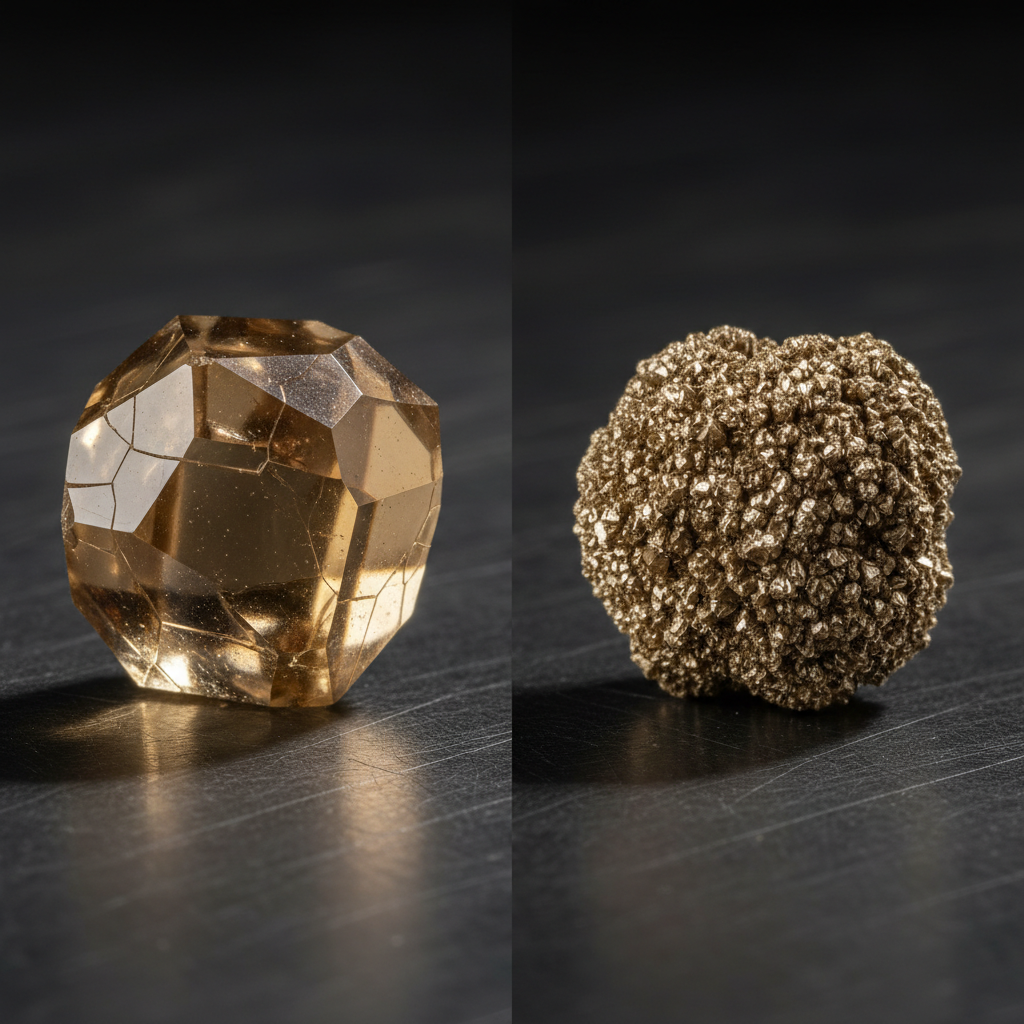
Monocrystalline CBN consists of individual, single-crystal grains typically produced through high-pressure, high-temperature (HPHT) synthesis. Each grain is a single continuous lattice structure with well-defined crystal planes. Typical grain sizes range from 60 mesh (250 microns) down to 325 mesh (45 microns), though specialty grades can push finer or coarser depending on the manufacturer.
The defining characteristic of monocrystalline CBN is how it fractures. Because the grain is one solid crystal, it tends to break along predictable cleavage planes when subjected to mechanical stress during grinding. This is important. When a monocrystalline grain fractures, it produces relatively sharp new cutting edges. But here is the catch: the fracture is often catastrophic at the grain level. A single cleavage event can remove a large portion of the grain, exposing fresh abrasive but also consuming grain volume in the process.
This behavior makes monocrystalline CBN well suited for applications where moderate grinding forces and controlled wear are priorities. In precision grinding of bearing races, for instance, monocrystalline grains maintain a consistent cutting action until they fracture, then re-sharpen quickly. The wheel does not glaze easily because the fracture pattern constantly exposes new edges. You get self-sharpening behavior, but at the cost of relatively rapid grain consumption.
Key performance characteristics of monocrystalline CBN include:
- Tensile strength of approximately 5.7 GPa, giving each grain high resistance to crushing
- Thermal conductivity around 13 W/m·K at room temperature, helping dissipate heat from the grinding zone
- Cleavage fracture along {111} crystal planes, producing large, sharp fragments
- Typical working temperature tolerance up to 1,300°C before chemical degradation becomes significant
- Grain shapes that tend toward blocky or angular morphologies depending on the synthesis conditions
Monocrystalline CBN is the traditional workhorse. It has decades of proven performance data behind it, and many grinding shops default to it simply because it is familiar and reliable. But familiarity should not be confused with superiority, because polycrystalline CBN offers a fundamentally different set of advantages.
How Polycrystalline CBN Changes the Grinding Equation
Polycrystalline CBN (PCBN) grains are sintered aggregates of many small crystallites bonded together into a single composite particle. Instead of one crystal lattice, you get hundreds or thousands of tiny grains fused under high pressure, typically at 5 to 6 GPa and temperatures around 1,400 to 1,800°C. The result is a grain with a very different internal structure and, critically, very different fracture mechanics.
When a polycrystalline CBN grain encounters the workpiece, it does not fracture along a single cleavage plane. Instead, micro-fractures propagate through the weaker boundaries between individual crystallites. This produces a gradual, controlled form of grain fracture that many engineers describe as “micro-self-sharpening.” Small chips break away from the grain surface, continuously exposing fresh abrasive without consuming the entire grain in one event.
This difference in grain fracture behavior has profound effects on grinding performance. Because the grain wears gradually rather than catastrophically, the cutting geometry remains more consistent over time. Surface finish values stay tighter. Grinding forces remain more stable throughout the wheel life. And the wheel itself tends to last longer because grain material is consumed more slowly.
The microstructure of polycrystalline CBN also means each grain effectively contains multiple cutting edges at the micro level. Where a monocrystalline grain might present one or two sharp edges after fracture, a polycrystalline grain presents a roughened surface with dozens of micro-edges. This is particularly valuable in finish grinding operations where surface integrity and low sub-surface damage are critical requirements.
Grinding Forces: Where the Real Differences Show Up
Grinding forces are where the monocrystalline vs polycrystalline CBN debate gets genuinely interesting. Tangential and normal forces during grinding are direct indicators of how hard the wheel is working, how much heat is being generated, and how much stress the workpiece surface is experiencing. Lower grinding forces mean less heat, less risk of thermal damage, and generally better surface integrity.
Research and production data consistently show that polycrystalline CBN wheels produce lower grinding forces than monocrystalline CBN wheels under comparable conditions. The numbers are not trivial. In creep-feed grinding of Inconel 718, polycrystalline CBN wheels have demonstrated 15 to 25% lower specific grinding forces compared to monocrystalline counterparts at the same material removal rates. In precision grinding of hardened tool steels (58 to 62 HRC), the advantage typically runs between 10 and 20%.
Why the difference? It comes down to grain fracture mechanics and cutting-edge sharpness. Polycrystalline grains maintain sharper micro-edges because of their continuous micro-fracture behavior. Sharper edges require less force to penetrate the workpiece material. The math is straightforward: lower force per cutting edge multiplied across thousands of active edges equals measurably lower total grinding forces.
Lower grinding forces also translate directly into reduced power consumption. A 15% reduction in tangential force at typical production grinding speeds (30 to 45 m/s wheel surface speed) can represent meaningful energy savings over a production year. For high-volume shops running CBN wheels on multiple machines, the cumulative effect adds up quickly.
That said, monocrystalline CBN has its own force-related advantages. Its fracture pattern, while more aggressive, keeps the wheel cutting freely. In rough grinding operations where high material removal rates are the priority and surface finish is secondary, the periodic sharp fracture of monocrystalline grains can actually maintain lower forces than a polycrystalline wheel that has started to load. The application context matters enormously.
Head-to-Head Comparison: Monocrystalline vs Polycrystalline CBN Performance
| Parameter | Monocrystalline CBN | Polycrystalline CBN |
|---|---|---|
| Grain structure | Single crystal lattice | Multiple sintered crystallites |
| Fracture mechanism | Cleavage along {111} planes | Micro-fracture at crystallite boundaries |
| Grinding forces (relative) | Baseline (100%) | 75 to 90% of baseline |
| Wheel life (typical) | Good | 20 to 40% longer |
| Surface finish consistency | Good, with periodic variation | Excellent, highly consistent |
| Best suited for | Rough grinding, interrupted cuts, high MRR | Finish grinding, tight tolerances, superalloys |
| Grain cost | Lower | Higher (30 to 50% premium) |
| Self-sharpening behavior | Catastrophic fracture, sharp re-exposure | Gradual micro-fracture, continuous sharpening |
| Thermal damage risk | Moderate | Lower |
| Grain hardness (micro-hardness) | ~4,500 HV | ~4,200 to 4,500 HV (varies with binder phase) |
Choosing the Right Bond System for Your CBN Grain Type
Grain structure does not operate in isolation. The bond system holding those grains in place has an enormous influence on how the wheel performs in practice. Vitrified bonds, resin bonds, and metal bonds each interact differently with monocrystalline and polycrystalline CBN grains, and matching the bond to the grain type is a critical engineering decision.
Vitrified bonds work exceptionally well with both grain types but tend to favor polycrystalline CBN in precision applications. The controlled porosity of vitrified bonds allows good chip clearance and coolant access, complementing the micro-fracture behavior of polycrystalline grains. For shops evaluating vitrified vs resin bond grinding wheels, the choice often comes down to whether the application prioritizes form-holding (vitrified) or conformability (resin).
Resin bonds pair naturally with monocrystalline CBN in many applications. The slight elasticity of the resin bond cushions the grain during the sudden fracture events, reducing the risk of grain pullout. This combination is popular in tool and cutter grinding where both sharp cutting action and reasonable wheel life are needed.
Metal bonds, used less frequently with CBN than with diamond, can work with either grain type but are generally reserved for applications requiring extreme wheel life and form-holding capability. The strong grain retention of metal bonds means grains do not release easily, which works well with polycrystalline CBN’s gradual wear pattern but can cause glazing with monocrystalline CBN unless the bond is carefully designed with friability modifiers.
For a deeper dive into how different bond types compare in cost and performance, the vitrified CBN vs electroplated CBN cost-benefit analysis provides detailed production data that many engineers find useful when planning wheel procurement.
Application-Specific Recommendations
The “which is better” question does not have a universal answer. It depends entirely on what you are grinding, how you are grinding it, and what your priorities are. Here are some practical guidelines based on common industrial scenarios.
Automotive camshaft and crankshaft grinding: Polycrystalline CBN in vitrified bonds is the standard choice. These are high-volume operations where consistency and wheel life directly affect cost per part. The lower grinding forces of polycrystalline CBN reduce thermal damage risk on hardened steel journals, and the gradual wear pattern means fewer wheel dressing cycles and less downtime.
Hardened tool steel die grinding: Monocrystalline CBN in resin bonds often delivers the best cost-performance balance. The interrupted cuts common in die grinding benefit from the sharp, periodic fracture of monocrystalline grains. Wheel life is still good, and the lower grain cost helps keep per-part costs competitive.
Nickel superalloy grinding (Inconel, Waspaloy, Hastelloy): Polycrystalline CBN is strongly preferred. These materials work-harden aggressively, and the lower grinding forces of polycrystalline CBN are essential to avoid surface damage. The high heat generation in superalloy grinding also makes the more consistent thermal behavior of polycrystalline grains a significant advantage.
Bearing race grinding: Both grain types work well, but the choice depends on whether you are rough or finish grinding. Monocrystalline CBN performs efficiently in roughing operations where high stock removal is needed. Polycrystalline CBN excels in the finishing passes where surface integrity and size consistency are critical. Many bearing manufacturers use both types in a two-stage process.
Understanding the difference between CBN and conventional abrasives is also important when making these decisions. If you are still evaluating whether CBN is the right abrasive for your application at all, our comparison of CBN vs diamond grinding wheels covers the fundamental differences between these superabrasive materials.
The Economics: Cost Per Part, Not Cost Per Grain
A common mistake when comparing monocrystalline and polycrystalline CBN is focusing on grain cost alone. Yes, polycrystalline CBN grains cost 30 to 50% more per kilogram than monocrystalline equivalents. But grain cost is only one factor in the total cost per part equation.
When you account for longer wheel life, fewer dressing cycles, lower energy consumption, and reduced scrap rates from thermal damage, polycrystalline CBN frequently delivers a lower cost per finished part despite the higher grain cost. In high-volume automotive grinding, the cost-per-part advantage of polycrystalline CBN can be 8 to 15% compared to monocrystalline CBN, even after accounting for the grain premium.
In lower-volume, job-shop environments, the calculation shifts. Shorter production runs mean the wheel-life advantage of polycrystalline CBN has less time to offset the initial cost premium. Monocrystalline CBN wheels, being less expensive upfront, often make more economic sense when wheel utilization rates are below 60%.
Summary: Matching Grain Structure to Your Grinding Goals
Monocrystalline CBN and polycrystalline CBN are not competing technologies. They are complementary tools, each optimized for different grinding scenarios. Monocrystalline CBN excels where sharp, periodic grain fracture keeps the wheel cutting freely in demanding rough-grinding conditions. Polycrystalline CBN dominates in applications requiring low grinding forces, consistent surface finish, and long wheel life on hard-to-grind materials.
The engineering principles are clear. If your priority is maximum material removal at the lowest grain cost, monocrystalline CBN is likely your best option. If you need the lowest grinding forces, the tightest surface finish tolerances, and the longest sustainable wheel life, polycrystalline CBN justifies its premium. And in many production environments, the smartest approach is using both grain types strategically across different operations in the same manufacturing cell.
As with all grinding decisions, the grain structure choice should be validated through systematic testing under your actual production conditions. Theory and data sheets get you 80% of the way there. The last 20% comes from running trials, measuring grinding forces, checking surface integrity, and tracking cost per part over meaningful production volumes.
Need Expert Guidance on CBN Wheel Selection?
Zhengzhou Zhongxin Grinding Wheel Co., Ltd. has been manufacturing high-performance CBN grinding wheels for over two decades. Whether your application calls for monocrystalline CBN, polycrystalline CBN, or a custom grain blend optimized for your specific grinding parameters, our engineering team can recommend the right wheel specification, bond system, and grain size for your needs. We work with shops and manufacturers across automotive, aerospace, bearing, and tool-grinding industries worldwide. Contact us today to discuss your application requirements, request sample wheels, or get a detailed cost-per-part analysis for your grinding process.
Tags: CBN, Grain Structure, Polycrystalline, Precision Grinding
Leave a Reply