
Optimizing Coolant Delivery for Precision Grinding: Beyond the Nozzle
You’ve just invested in a high-performance vitrified CBN wheel. The grit size is perfect. The bond hardness is exactly what the application engineer recommended. You hit the cycle start button, and within ten minutes, the workpiece is covered in blue burn marks. Your first instinct is to call the wheel manufacturer and complain about a “hard” wheel. Before you pick up the phone, look at your coolant nozzles. Are they actually delivering fluid to the grinding zone, or are they just washing the guards? In many high-precision shops, coolant delivery is the most misunderstood and underestimated variable in the entire production process.
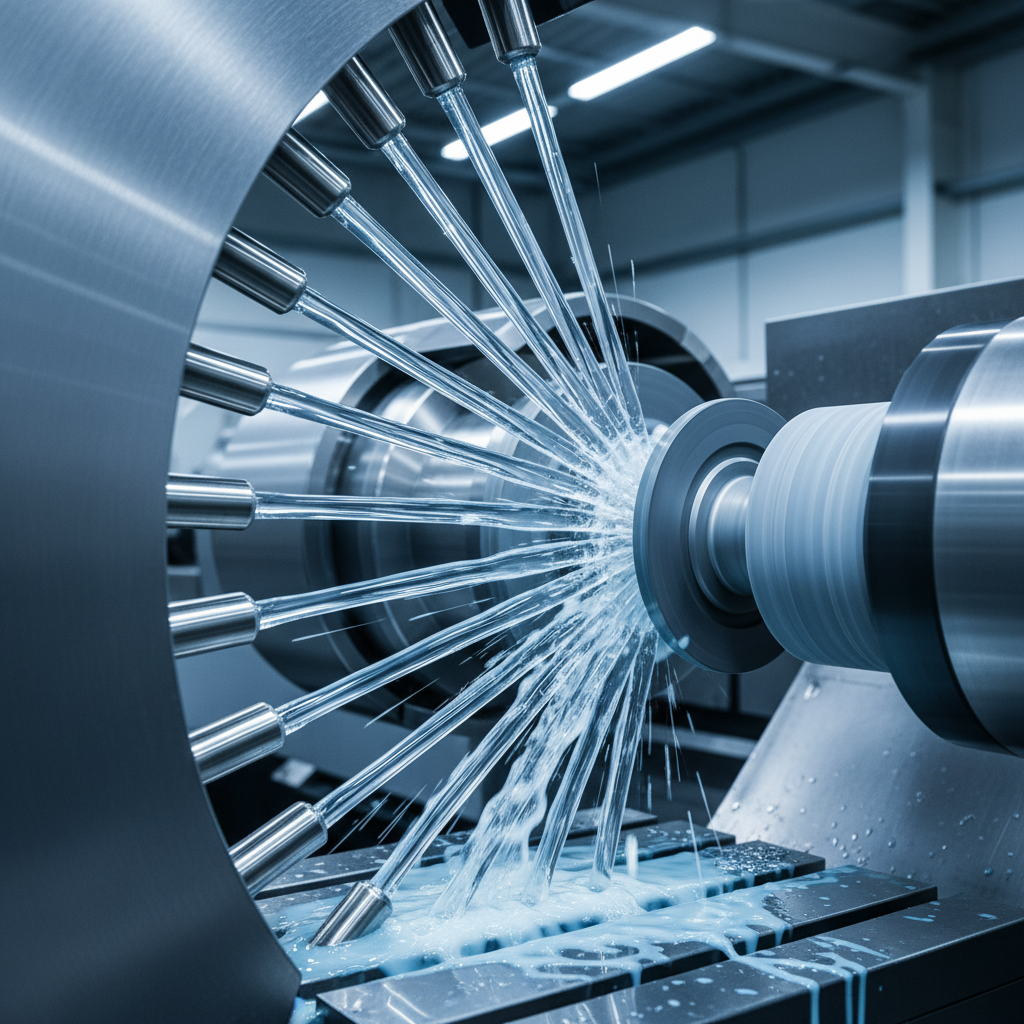
Grinding is essentially a heat generation process where we happen to remove metal. About 90% of the energy used in grinding converts into heat. If that heat stays in the workpiece, the metallurgy changes. You get residual tensile stresses, cracks, and softening. The coolant’s job isn’t just to keep things “cool.” It must lubricate the abrasive grains, flush away chips, and prevent the wheel from loading. Most importantly, it has to get past the invisible wall of air that protects every high-speed grinding wheel.
The Air Barrier Problem: Why Your Coolant Never Reaches the Grind Zone
A grinding wheel spinning at high speed acts like a centrifugal fan. It drags a layer of air along its periphery. This is the air boundary layer. As wheel speeds increase, this layer becomes a high-pressure hydrodynamic barrier. If your wheel is running at 35 m/s or faster, it creates a “wind” that can easily deflect low-pressure coolant streams. You might see fluid splashing everywhere, but the actual contact point—the “nip”—is bone dry. This is called film boiling. The fluid turns to steam before it can touch the metal.
The technical reality is simple. At wheel speeds above 30 m/s, the air barrier becomes dense enough to repel fluid delivered by standard plastic “loc-line” hoses. When the coolant can’t penetrate this layer, the temperature at the interface spikes to 800°C or higher in milliseconds. You aren’t grinding anymore; you’re friction welding.
To solve this, you must match the coolant jet velocity to the wheel’s surface speed. The goal is to “punch” through the air barrier. If your wheel is moving at 40 m/s, your coolant should also be moving at 40 m/s. This allows the fluid to travel with the wheel into the grind zone rather than being blown away. You can calculate jet velocity using the pump pressure. For example, 10 bar of pressure typically yields a jet velocity of around 45 m/s. If you’re running at 2 bar, your jet is only moving at about 20 m/s. It won’t stand a chance against a high-speed wheel.
Pressure vs. Flow Rate: The Critical Balance
We often hear operators say they need “more coolant.” Usually, they mean more flow, but sometimes they actually need more pressure. These two factors serve different masters. Flow rate, measured in L/min, is responsible for bulk heat removal. It carries the calories away from the machine bed and the workpiece. Pressure, measured in bar or PSI, is what ensures the fluid reaches the right spot and cleans the wheel pores.
For standard surface grinding, a flow rate of 1.5 to 2.0 liters per minute for every millimeter of wheel width is the industry standard. If you have a 50mm wide wheel, you need at least 75 L/min. Pressure can stay relatively low here, around 2-4 bar, provided the nozzle is positioned perfectly. However, the game changes with creep feed grinding or deep slotting. In these applications, the contact arc is long. The chips have nowhere to go. They get trapped in the wheel pores and rub against the workpiece, causing massive heat spikes.
In creep feed scenarios, you need “scrubbing” pressure. This is typically between 10 and 20 bar. This high pressure doesn’t just cool; it mechanically blasts the chips out of the wheel structure before the wheel rotates back into the cut. Without this high-pressure cleaning, the wheel “loads,” the grinding forces skyrocket, and the spindle load climbs until the machine trips or the part is ruined.
Nozzle Design and Positioning
The shape of your coolant stream matters as much as the pressure. Most shops use generic fan nozzles because they cover a wide area. This is a mistake for precision work. Fan nozzles cause the fluid to atomize and lose velocity quickly. By the time the fluid travels 100mm from the nozzle tip, it has slowed down significantly and lost its directional focus. It becomes a mist, not a jet.
Coherent jet nozzles are the gold standard. These are engineered to keep the fluid in a solid, glass-like pillar for a much longer distance. They maximize the kinetic energy of the fluid. When using coherent nozzles, you can maintain high velocity even if the nozzle is 200mm away from the grind zone. However, distance is still your enemy. Always position the nozzle as close as possible to the contact point.
The angle of delivery is the next critical factor. You should aim the jet 10-15 degrees from the wheel tangent, pointing directly into the “nip” where the wheel meets the part. Don’t aim at the wheel face several inches above the cut. By the time that fluid reaches the cut, centrifugal force has already thrown half of it off the wheel. You want the fluid to be “wedged” into the interface by the rotation of the wheel itself.
- Rigidity: Use stainless steel or copper tubing for nozzles. Plastic hoses vibrate and move under high pressure.
- Width: The nozzle should be slightly wider than the wheel to ensure the edges are cooled.
- Manifolds: Use a manifold to provide multiple aim points for complex part geometries.
Coolant Chemistry for Different Materials
One fluid does not fit all. The chemistry of your coolant affects everything from surface finish to the lifespan of your machine’s seals. Water-soluble oils (emulsions) are the workhorses of the industry. Because water has a high specific heat capacity, these fluids are excellent at removing heat. They’re the go-to choice for grinding various steels where thermal damage is the primary concern.
Straight oils provide the best lubricity. They reduce the friction between the abrasive grain and the metal, which actually prevents heat from being generated in the first place. Oil is essential for carbide grinding. Why? Because water-based fluids can cause “cobalt leaching.” Cobalt is the binder that holds carbide together. If it leaches out, the tool becomes brittle and prone to chipping. Straight oil also extends wheel life significantly by reducing bond erosion.
Synthetic fluids are common when using Superabrasives like CBN. They offer great chemical stability and don’t leave the gummy residues that some oils do. They also provide better clarity, which helps operators see the part. Regardless of the type, you must monitor pH levels. Aim for a pH between 8.8 and 9.2. If it drops below 8.5, bacteria will flourish, and your machine will start to rust. If it goes above 9.5, it can cause skin irritation for operators and damage the paint on your equipment.
Signs Your Coolant System Is Failing
You don’t always need a sensor to tell you something is wrong. The parts and the machine will tell you if you know what to look for. Frequent dressing is often a sign of poor cooling, not a bad wheel. If you have to dress the wheel every three parts because it’s loaded with metal, your coolant isn’t flushing the chips effectively.
| Symptom | Likely Cause | Recommended Fix |
|---|---|---|
| Visible blue/brown burn marks | Film boiling (air barrier) | Increase pump pressure to match jet velocity to wheel speed. |
| Frequent wheel loading/clogging | Insufficient flushing | Add a high-pressure scrubbing nozzle (15+ bar). |
| Poor surface finish (scratches) | Dirty coolant (recirculating fines) | Improve filtration system or clean the coolant tank. |
| Sudden wheel wear | Lack of lubricity | Check coolant concentration or switch to straight oil. |
| Workpiece dimensional drift | Bulk heat buildup | Increase total flow rate (L/min) to stabilize machine temperature. |
Don’t ignore the smell either. A “rotten egg” odor indicates anaerobic bacteria growth. This usually happens in stagnant areas of the tank. Not only is it unpleasant, but it also changes the fluid’s lubricity and can lead to inconsistent grinding results. Regular concentration checks with a refractometer are mandatory. Don’t guess. A 5% concentration looks exactly like a 2% concentration to the naked eye, but the performance difference is massive.
Conclusion
Precision grinding is a system. The wheel, the machine, and the coolant must work in harmony. You can have the best wheel in the world, but if the coolant can’t get past the air barrier, you’ll never reach your production goals. We’ve seen shops double their feed rates simply by switching from plastic hoses to rigid, coherent nozzles and bumping up their pump pressure. It’s the cheapest way to increase productivity without buying a new machine.
At Zhengzhou Zhongxin Grinding Wheel Co., Ltd., we design our vitrified and resin-bonded wheels to handle the highest speeds and toughest materials. We know that our products perform best when they’re supported by a robust cooling strategy. If you’re struggling with thermal damage or poor wheel life, it’s time to look beyond the nozzle. Optimize your delivery, match your velocities, and watch your grinding efficiency soar. Our technical team is always ready to help you match the right wheel to your specific coolant capabilities to ensure every part you grind is perfect.
Leave a Reply