


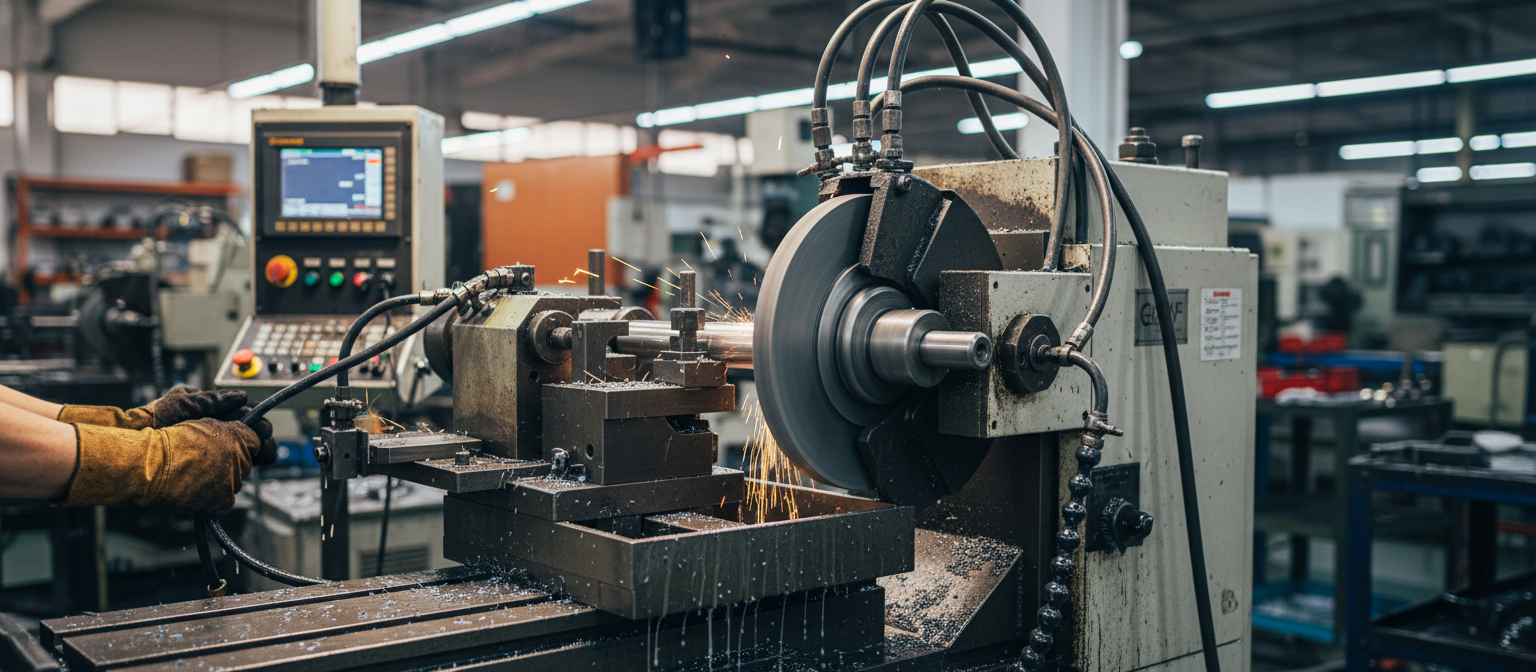
In high-precision manufacturing, producing flawless tungsten carbide rods and tool blanks is a balancing act. Tungsten carbide (WC-Co) is revered for its extreme hardness and wear resistance, but these exact properties make it a nightmare to grind. During centerless grinding, operators frequently hit a double-whammy of failure modes: high-frequency chatter marks and severe thermal burn.
If you’ve spent any time on a centerless grinding shop floor, you know the drill. You hear that high-pitched whine, and suddenly your smooth carbide rods are covered in spiral wave-like lines. Or worse, you spot the telltale dark oxidation of thermal burn, meaning the cobalt binder has depleted, leaving micro-cracks that will cause the tool to snap under load. At Zhengzhou Zhongxin Grinding Wheel Co., Ltd., we’ve analyzed hundreds of these cases. The solution isn’t magic; it is a systematic combination of rigid setup adjustments, precise kinematic parameters, and the strategic deployment of open-structure grinding wheels.
The Core Conflict: Why Tungsten Carbide Resists Conventional Grinding
To solve the problems of chatter and burn, we must first understand the physics of the grinding zone. Tungsten carbide is highly brittle and has a relatively low thermal conductivity compared to steels. When grinding, the mechanical energy expended by the abrasive grains is almost entirely converted into heat. In a standard, dense-bond diamond wheel, the micro-chips of carbide (which are incredibly fine and abrasive) have nowhere to go. They become tightly packed between the abrasive grains. This phenomenon is known as wheel loading.
Once loading occurs, the diamond grains can no longer penetrate the material. Instead of clean micro-cutting, the wheel begins to plow and rub against the carbide. This drastically spikes the coefficient of friction. The temperature in the grinding zone climbs instantly, exceeding the critical threshold where the cobalt binder phase begins to soften and bleed out. This thermal stress generates tensile stresses on the carbide surface, manifesting as microscopic thermal cracks. Furthermore, as the wheel loads and loses its cutting efficiency, grinding forces escalate. When these forces exceed the dynamic stiffness of your centerless grinding system, the entire setup begins to vibrate, leaving deep chatter marks across the workpiece surface.
Kinematic Parameters: Designing a Conservative and Safe Process Window
Before swapping out any hardware, the first step in troubleshooting must be auditing your process parameters. Because carbide is highly sensitive to thermal loading, you cannot run it like standard hardened steel. We recommend establishing a strict, conservative parameter window. The table below outlines our field-tested standards for carbide rod grinding:
| Process Parameter | Recommended Value for Carbide | Impact on Burn & Chatter Control |
|---|---|---|
| Wheel Speed (v_s) | 20 – 35 m/s (4,000 – 7,000 SFM) | Keeping wheel speed conservative limits the rate of friction-induced heat. Higher speeds spike temperatures rapidly. |
| Regulating Wheel Speed | 10 – 16 RPM (for finish pass) | Slower regulating speeds ensure stable work rotation, improving overall roundness and mitigating geometric “lobing”. |
| Roughing Infeed / Depth of Cut | 0.01 – 0.03 mm per pass | Moderate depth of cut balances material removal rates while keeping mechanical forces within the system’s rigid limit. |
| Finishing Infeed / Depth of Cut | < 0.005 mm per pass | Ultra-light finishing cuts eliminate subsurface micro-cracks and prevent micro-chipping on delicate tool blank edges. |
Operating outside of these parameters will inevitably lead to trouble. For instance, running a diamond grinding wheel at 45 m/s or higher on a brittle tungsten carbide rod without an exceptionally optimized coolant delivery system will cause instantaneous thermal shock. Keep your speeds in the safe 20 to 35 m/s range. Start with shallow cuts and gradually ramp up based on the rigidity of your machine.
Eliminating Chatter Marks: Rigidity, Geometry, and Center-Height Adjustments
Chatter in centerless grinding is primarily a geometric and structural issue. Because the work is supported externally on a work rest blade between the grinding wheel and regulating wheel, any misplacement can trigger unstable, regenerative vibrations.
To eliminate chatter and roundness issues like “lobing” (where the rod becomes a rounded polygon rather than a perfect cylinder), you must carefully adjust the height of the work blade. As a golden rule, the workpiece centerline (工件中心线) must be positioned above the centerline of the grinding and regulating wheels. Specifically, set the workpiece center height (工件中心高度) to **0.5 to 1.0 times the workpiece diameter** above the wheel centerlines. This specific offset causes the grinding forces to push the workpiece downward into the angle of the work rest blade, creating a self-damping wedge effect. If the center height is too low, the workpiece will bounce horizontally between the wheels, causing severe chatter.
Additionally, pay close attention to your work rest blade. For standard carbide rod grinding, we recommend a **30-degree top-angle work rest blade**. This angle provides the ideal balance between vertical support and horizontal stability. However, if you are grinding particularly heavy or large-diameter carbide rods, a 30-degree angle might induce excessive lateral forces. In such cases, reduce the blade angle to 20 or 25 degrees to increase system rigidity and eliminate resonance-induced chatter marks.
The Game Changer: Open-Structure Wheels and Loading Prevention
Even with perfect geometry and moderate speeds, a standard grinding wheel will eventually load up when grinding carbide, leading to eventual thermal burn. To prevent this, manufacturers must transition to **open-structure grinding wheels**.
Traditional grinding wheels feature a dense, tightly packed arrangement of abrasive grains and bond material. Open-structure wheels, by contrast, are engineered with a highly porous, interconnected network of artificial pores. This architectural difference provides three massive technical advantages:
- Interconnected Pockets for Chip Clearance: The large, open pores act as built-in “pockets” that temporarily house the ultra-fine carbide dust generated during grinding. Instead of being forced into the face of the wheel and causing loading, the chips are carried safely out of the grinding zone and flushed away.
- High-Velocity Coolant Transport: Standard grinding wheels generate a boundary layer of high-speed air around their circumference that deflects coolant. The open pores of an open-structure wheel break this aerodynamic barrier, drawing coolant deep into the wheel and releasing it directly into the grinding contact arc.
- Superior Self-Sharpening (Self-Dressing) Action: Our open-pore wheels are paired with a precisely formulated bond. When the active diamond abrasive grains become dull, the high-porosity structure allows the bond to break down predictably, releasing the worn crystals and exposing sharp, fresh diamond edges. This self-sharpening mechanism keeps the grinding force consistently low and stable, eliminating the mechanical spikes that trigger chatter.
Synergy with Fluid Dynamics: High-Pressure Coolant and Water Hardness
An open-structure wheel is only as good as the coolant system supporting it. To fully exploit the pore structure, you must pair the wheel with High-Pressure Coolant (HPC) systems, typically operating at 50 to 100 bar. The high-velocity coolant jets must be aimed precisely at the grinding nip to scrub the wheel surface clean of metal debris before it re-enters the cut.
Furthermore, never overlook water chemistry. The mineral content of your grinding fluid water directly dictates wheel life and surface finish. We advise maintaining water hardness strictly between **125 to 200 ppm (parts per million)**. Here is why this specific range is non-negotiable:
- If Water Hardness is too Low (<125 ppm): The water is overly “soft”. In a high-pressure coolant system, soft water will foam excessively. This foam introduces millions of microscopic air bubbles into the fluid, severely reducing its thermal conductivity and lubrication. The result is rapid thermal burn, despite high coolant flow.
- If Water Hardness is too High (>200 ppm): The water is “hard”. High mineral content causes scale and calcium deposits to build up inside the open pores of your grinding wheel. This mineral scaling clogs the open structure, negating its chip-clearance advantages and causing rapid wheel loading.
Always use a water filtration and conditioning system to keep your hardness levels within the 125-200 ppm window. When this chemical balance is paired with an open-structure vitrified or resinoid diamond wheel, the risk of thermal burn on carbide is virtually eliminated.
Practical Checklist for Centerless Grinding Operators
If you are currently facing chatter or thermal burn issues on your centerless grinding line, run through this practical checklist before your next shift:
- Check Center Height: Confirm the rod’s center is 0.5 to 1.0 times its diameter above the wheel centerlines. Adjust the height of the work rest blade accordingly.
- Inspect the Blade: Ensure the top of the work rest blade has a 30-degree angle. Check for wear or grooving on the blade surface; an uneven blade is a primary source of chatter.
- Verify Wheel Speed: Drop your grinding wheel speed down into the safe 20 to 35 m/s window. Avoid excessive speeds that generate localized heat spikes.
- Test Coolant Hardness: Pull a sample of your grinding fluid water and test its hardness. If it is outside 125 to 200 ppm, treat the water immediately to prevent either foaming or mineral scaling.
- Switch to Open-Structure: If you are still using a standard, dense-structure wheel and experiencing wheel loading, contact your supplier to transition to an open-structure diamond grinding wheel.
Contact Zhengzhou Zhongxin Grinding Wheel Co., Ltd. for Engineering Support
At Zhengzhou Zhongxin, we specialize in high-performance grinding solutions tailored to the world’s most demanding materials. If you are struggling with carbide centerless grinding parameters, surface burn, or persistent chatter marks, our engineering team is here to help. We design and manufacture custom open-structure diamond grinding wheels and regulating wheels that deliver exceptional self-sharpening action and thermal control.
Reach out to our technical support team today for a comprehensive consultation:
Zhengzhou Zhongxin Grinding Wheel Co., Ltd.
Email: root@shalun.net
Mobile/WeChat: +86-15538050608
Phone: +86-371-62513386
Physical Address: No. 1111-1, Kexue Avenue, Shangjie District, Zhengzhou City, Henan Province, China (河南省郑州市上街区科学大道1111-1号)