


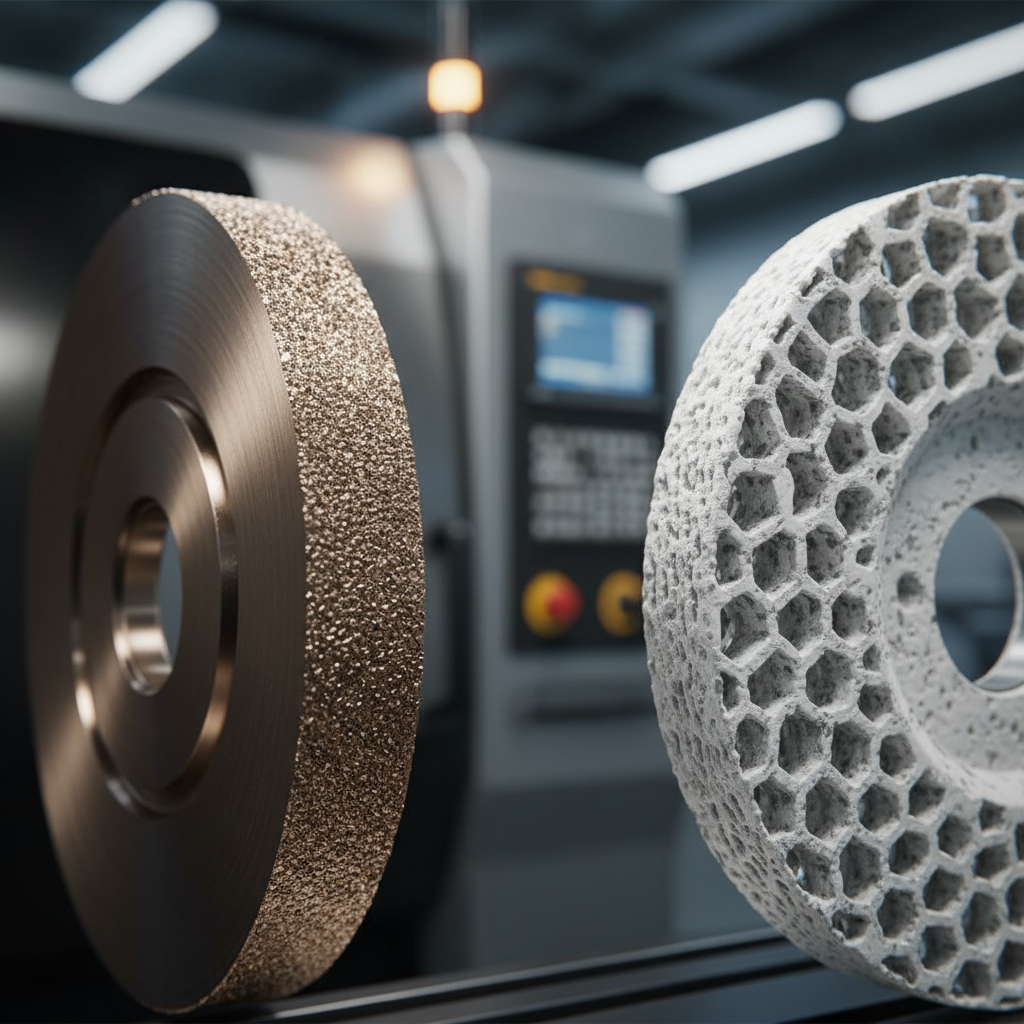
金属结合剂金刚石砂轮与陶瓷结合剂金刚石砂轮:硬质合金和陶瓷的优缺点
In the highly demanding field of precision grinding, selecting the optimal superabrasive wheel is not merely a matter of preference; it is a critical engineering decision that dictates manufacturing efficiency, part quality, and overall production costs. For industries machining extraordinarily hard materials like tungsten carbide and advanced ceramics, diamond grinding wheels are the undisputed standard. However, the abrasive grain alone does not determine a wheel’s performance. The matrix that holds these diamond grains—the bond—is equally vital.
Among the various bonding systems available, metal bond and vitrified (ceramic) bond diamond wheels represent two of the most robust and technologically advanced options. Each bond type presents a unique set of metallurgical and mechanical characteristics, offering distinct advantages and limitations depending on the application. This comprehensive guide explores the critical trade-offs between metal bond and vitrified bond diamond wheels, specifically focusing on their performance in carbide grinding and ceramic grinding applications.
Understanding Diamond Wheels: A Brief Overview
Before diving into the specifics of bond types, it is essential to understand how diamond grinding wheels function. A diamond wheel consists of synthetic diamond grits suspended within a bonding matrix, which is then attached to a core material (typically steel, aluminum, or composite). The diamond grits act as microscopic cutting tools, shearing away material from the workpiece. As the grinding process continues, the diamond grits wear down and become dull. The ideal bonding matrix must hold the diamonds firmly enough to maximize their cutting life but break away (or wear) at a controlled rate to expose fresh, sharp diamond edges—a process known as self-sharpening.
If the bond is too hard, the dulled diamonds remain trapped, leading to increased friction, heat generation, and potential thermal damage to the workpiece. Conversely, if the bond is too soft, the diamonds are released prematurely, resulting in rapid wheel wear and poor dimensional control. The choice between metal and vitrified bonds hinges on finding the perfect equilibrium for the specific material being ground.
金属结合金刚石轮毂
Metal bond diamond wheels utilize a matrix composed of sintered metal powders—most commonly bronze, copper, iron, or cobalt alloys. The manufacturing process involves pressing the diamond-metal powder mixture into a mold and sintering it at high temperatures to create a dense, highly durable structure.
Characteristics
Metal bonds are characterized by their extreme toughness and superior grain retention. The metallic matrix mechanically grips the diamond grits with immense force, ensuring they are not easily dislodged during aggressive grinding operations. This creates a dense wheel structure with low porosity.
Advantages
- Exceptional Durability and Long Wheel Life: Because the metal matrix wears away very slowly, metal bond wheels offer the longest operational lifespan among all bond types. This makes them highly economical for high-volume production runs where minimizing tool changeovers is crucial.
- Excellent Shape Retention: The rigidity and toughness of the metal bond allow these wheels to maintain their precise profile and dimensional accuracy over extended periods, making them ideal for form grinding and profile grinding.
- High Heat Conductivity: The metallic matrix excels at dissipating heat away from the grinding zone. This is particularly beneficial when grinding heat-sensitive materials or operating under heavy loads, reducing the risk of thermal damage.
Limitations
- Poor Self-Sharpening Ability: The primary drawback of metal bonds is their reluctance to release dull diamond grits. As the diamonds blunt, the wheel tends to “glaze” over, requiring frequent and aggressive dressing with abrasive sticks (typically aluminum oxide or silicon carbide) to expose fresh diamonds.
- Slower Material Removal Rates: Because the wheel does not self-sharpen efficiently, cutting speeds and feed rates must often be reduced compared to softer bonds to prevent excessive heat build-up and workpiece burning.
- Difficult Truing and Dressing: Preparing a metal bond wheel for operation is a time-consuming and challenging process that requires specialized dressing equipment and significant operator skill.
Ideal Applications
Metal bond diamond wheels are the go-to choice for applications requiring extreme durability and shape retention, such as grinding glass, refractories, stone, and certain hard ceramics where heavy stock removal is secondary to wheel longevity and profile accuracy.
Vitrified (Ceramic) Bond Diamond Wheels
Vitrified bond diamond wheels—often referred to as ceramic bond wheels—employ a matrix made of a carefully formulated mixture of clays, feldspars, and glass frits. The manufacturing process involves pressing the mixture and firing it in a kiln, causing the ceramic materials to fuse and create a rigid, porous structure containing the diamond grits.
Characteristics
Vitrified bonds are rigid, highly porous, and inherently brittle. Unlike metal bonds that mechanically grip the diamonds, vitrified bonds form a chemical and mechanical adhesion. The defining characteristic of vitrified wheels is their controlled porosity, which can be engineered during manufacturing to suit specific applications.
Advantages
- Superior Self-Sharpening Capability: Vitrified bonds are designed to be brittle. As grinding forces increase on a dulling diamond grit, the ceramic bond fractures and releases the grit, exposing a sharp new diamond. This continuous self-sharpening action maintains a free-cutting wheel surface.
- High Material Removal Rates: Because the wheel remains constantly sharp, vitrified bonds allow for significantly higher feed rates and faster grinding speeds, dramatically improving productivity and reducing cycle times.
- Excellent Coolant Delivery: The inherent porosity of vitrified wheels allows cutting fluids to penetrate deep into the grinding zone. This not only enhances cooling but also helps flush away swarf (grinding debris), preventing wheel loading and surface blemishes.
- Ease of Truing and Dressing: Compared to metal bonds, vitrified wheels are much easier to true and dress. They can often be conditioned using standard rotary diamond dressers, saving substantial setup time.
Limitations
- Lower Impact Resistance: The brittle nature of the ceramic matrix makes vitrified wheels susceptible to chipping or breaking under sudden impact or severe interrupted cuts. Machine rigidity and precise spindle alignment are critical.
- Shorter Wheel Life: The continuous self-sharpening process inherently leads to faster wheel wear compared to metal bonds. While productivity is higher, the frequency of wheel replacement is also greater.
- Complex Manufacturing and Higher Initial Cost: Formulating and firing vitrified diamond wheels is a highly specialized process, often resulting in a higher initial purchase price compared to standard resin or metal bond wheels.
Carbide Grinding: Which Bond Wins?
Tungsten carbide is notoriously hard, brittle, and heat-sensitive, presenting a unique set of challenges in manufacturing and tool sharpening. Selecting the right wheel is crucial, as detailed in our guide on how to choose grinding wheels for carbide tool sharpening.
Historically, resin bond diamond wheels have dominated carbide tool grinding due to their forgiving nature and good surface finish. However, as manufacturers demand higher productivity and tighter tolerances, metal and vitrified bonds are increasingly utilized.
Metal Bond for Carbide: Metal bonds are generally reserved for off-hand grinding or heavy-duty roughing of large carbide inserts where shape retention and wheel life are paramount. The risk of thermal damage to the carbide is high if the wheel glazes, so abundant coolant and careful parameter control are essential. For precision tool sharpening, metal bonds are typically too slow and prone to burning the delicate cutting edges.
Vitrified Bond for Carbide: Vitrified diamond wheels are revolutionizing high-production carbide grinding, particularly in CNC tool and cutter grinders. Their free-cutting nature minimizes heat generation, virtually eliminating the risk of thermal micro-cracking in the carbide. The high porosity allows for excellent swarf evacuation and coolant delivery, enabling extremely high material removal rates while maintaining superb dimensional accuracy. For automated, high-volume carbide insert and round tool manufacturing, vitrified bonds offer an unbeatable combination of speed and precision.
Ceramic Grinding: Navigating Brittle Materials
Advanced technical ceramics—such as alumina, zirconia, and silicon carbide—are exceptionally hard and inherently brittle. They are highly susceptible to subsurface damage and micro-fracturing during the grinding process. Understanding the mechanics of ceramic bond grinding wheels is essential when machining these demanding materials.
Metal Bond for Ceramics: Metal bond diamond wheels have traditionally been the standard for grinding structural ceramics, glass, and quartz. Their incredible durability allows them to withstand the highly abrasive nature of these materials. In applications like edge grinding of glass or heavy stock removal on large ceramic plates, metal bonds provide unmatched longevity. However, the grinding pressure required to make a metal bond wheel cut can sometimes induce unwanted stress or chipping in delicate ceramic components.
Vitrified Bond for Ceramics: When precision, surface integrity, and high throughput are required, vitrified bonds excel in ceramic grinding. The sharp, free-cutting action of a vitrified wheel requires significantly less grinding pressure than a metal bond wheel. This reduction in normal forces minimizes the risk of introducing subsurface cracks or edge chipping in the brittle ceramic workpiece. For tight-tolerance applications like grinding ceramic bearings, semiconductor components, or medical implants, the vitrified bond’s ability to cut cleanly and stay sharp makes it the superior choice.
Head-to-Head Comparison Table
| Feature / Characteristic | 金属结合金刚石轮毂 | 玻化结合金刚石砂轮 |
|---|---|---|
| Matrix Material | Sintered metal alloys (Bronze, Steel, Cobalt) | Fired ceramic/glass frits |
| Porosity | Low (Dense structure) | High (Engineered porosity) |
| Self-Sharpening Ability | Poor (Requires frequent dressing) | Excellent (Continuous free-cutting) |
| Material Removal Rate (MRR) | Low to Moderate | High to Very High |
| Wheel Life / Durability | Exceptional (Longest lifespan) | Moderate (Consumes faster due to self-sharpening) |
| Shape / Profile Retention | 出色的 | Good to Very Good |
| Heat Generation at Workpiece | High (Risk of thermal damage if glazed) | Low (Cool, free-cutting action) |
| Impact Resistance | High | Low (Brittle, prone to chipping) |
| Ease of Truing and Dressing | Difficult and time-consuming | Relatively easy |
Cost vs. Performance: A Purchasing Manager’s Perspective
For procurement professionals and manufacturing engineers, evaluating the total cost of ownership (TCO) is more critical than simply comparing the initial purchase price of grinding wheels. For broader context on superabrasive selection, reviewing CBN vs Diamond Grinding Wheels: What is the Difference can provide valuable insights.
Metal bond wheels generally present a lower cost-per-part in terms of abrasive consumption. Because they wear so slowly, a single wheel can process an enormous volume of material. However, this calculation often ignores the hidden costs of lower productivity, longer cycle times, and the intensive labor required for frequent offline dressing and conditioning.
Vitrified bond wheels usually carry a higher initial price tag and will be consumed more rapidly than their metal bond counterparts. However, the dramatic increases in material removal rates, reduced cycle times, and the elimination of offline dressing downtime often result in a significantly lower overall manufacturing cost-per-part. In high-overhead CNC operations, the time saved by a free-cutting vitrified wheel easily offsets its higher abrasive cost.
The decision ultimately comes down to the operational bottleneck. If machine time and throughput are the primary constraints, vitrified wheels are the undisputed champions. If wheel longevity and minimizing abrasive spend on less critical operations are the goals, metal bonds remain highly viable.
结论
The choice between metal bond and vitrified bond diamond wheels is a fundamental engineering decision that dictates the success of carbide and ceramic grinding operations. Metal bonds offer unparalleled durability and shape retention, making them ideal for heavy-duty roughing and grinding highly abrasive materials where wheel life is the primary concern.
Conversely, vitrified bond diamond wheels represent the pinnacle of precision and productivity. Their engineered porosity, exceptional self-sharpening capabilities, and cool cutting action make them the optimal choice for high-volume CNC grinding of sensitive materials like tungsten carbide and advanced technical ceramics.
By carefully analyzing the specific requirements of the workpiece material, the required tolerances, and the economic drivers of the production environment, manufacturers can select the optimal bonding system to maximize efficiency, enhance part quality, and optimize their overall grinding process.