


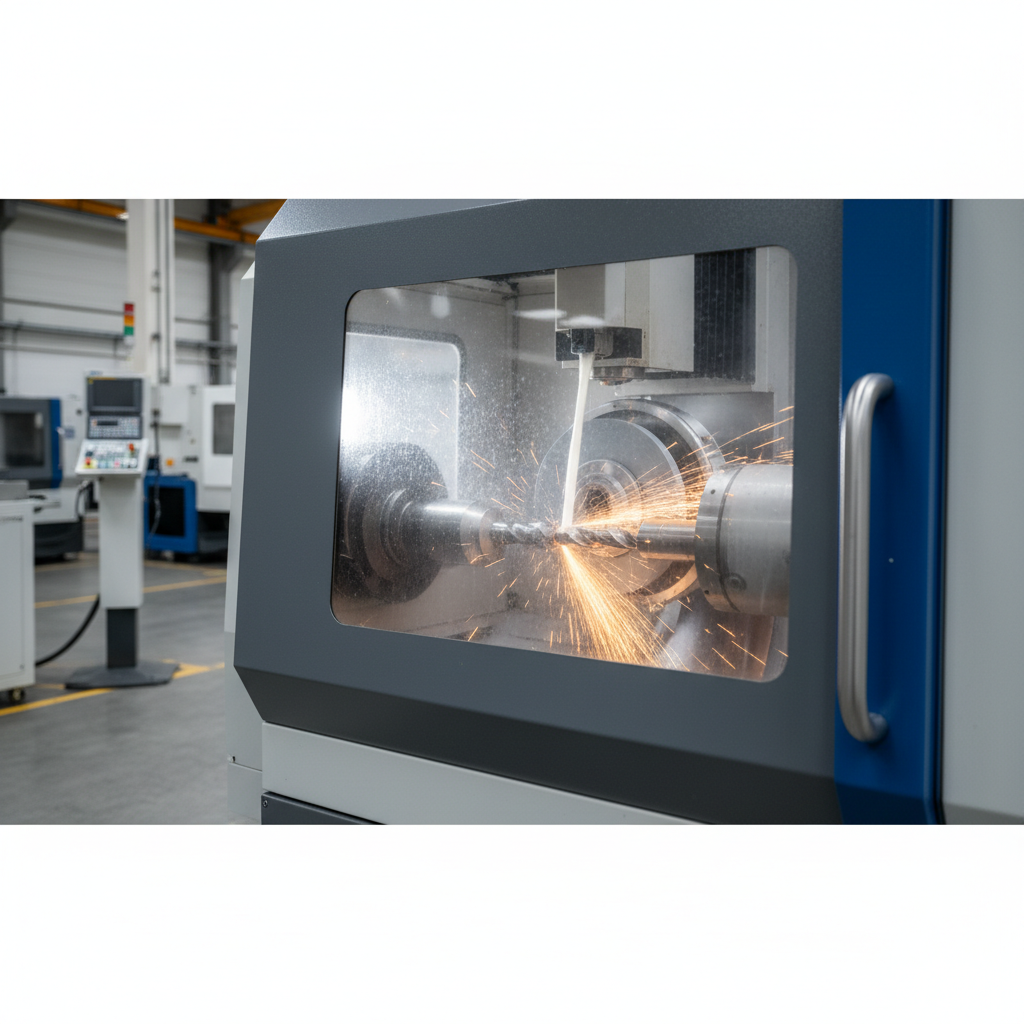
Why Hardened Steel Grinding Is a Different Beast
You already know that grinding a soft low-carbon shaft isn’t the same as touching off on a hardened D2 punch. The hardness changes everything: how the abrasive breaks down, how heat builds up, and whether you walk away with a good part or a scrapped one. Hardened steel grinding demands more respect for abrasive selection, wheel specification, and process control than almost any other grinding application.
Here’s the core principle that separates good shops from frustrated ones: you need a soft-grade wheel on hard material, and a hard-grade wheel on soft material. That sounds counterintuitive, but it’s been gospel in grinding for decades. When the workpiece is hard (60+ HRC), the abrasive grains dull quickly because there’s nowhere for the chip to go. A softer grade wheel releases those dull grains faster, exposing fresh, sharp cutting edges. Push a hard-grade wheel on hardened HSS and you’ll glaze it in minutes, generate massive heat, and burn the part.
This article covers the practical side of grinding three of the most common tool steels: HSS (M2, M42), D2 cold-work die steel, and other hardened tool steels like A2, O1, and S7. We’ll get into wheel specs, grit sizes, coolant strategy, and the numbers that actually matter on the shop floor.
Understanding Tool Steel Hardness and Grindability
Not all hardened steels behave the same under the wheel. The alloy composition, carbide type, and hardness level all affect how the material grinds. Let’s break down the big three:
HSS (High-Speed Steel): M2 and M42
M2 is the workhorse of HSS. After heat treatment, it lands at 62 to 65 HRC. It contains a high volume of tungsten and molybdenum carbides, which makes it abrasive and tough on grinding wheels. M42 takes it further. With about 8% cobalt in the mix, it hardens up to 65 to 67 HRC and the carbides are even more stubborn. HSS grinding produces significant heat because those carbides resist shearing, so the grinding zone gets hot fast.
Typical HSS applications include twist drills, end mills, reamers, and taps. If you’re regrinding cutting tools, surface finish on the flute or land directly affects tool performance. A rough finish on a drill land increases friction and heat during drilling, so you can’t just eyeball it and call it done.
D2 Cold-Work Die Steel
D2 sits at 58 to 62 HRC after hardening. It’s a high-carbon, high-chromium tool steel with a lot of chromium carbide. Those carbides are large and hard. Because of this, D2 has a reputation for being unforgiving during grinding. The carbides pull out rather than cut cleanly if you push too hard, leading to micro-chipping on the ground surface. This is one of the most common complaints we hear from die shops.
Compared to HSS, D2 has lower thermal conductivity, so heat concentrates at the surface. That makes it more susceptible to grinding burn, which can ruin the die. Burned D2 develops a rehardened white layer that’s brittle and will crack in service.
Other Common Tool Steels: A2, O1, S7
A2 is air-hardened to about 57 to 62 HRC. It’s a little easier to grind than D2 because the carbides are finer and more evenly distributed. O1, an oil-hardened tool steel, reaches 57 to 62 HRC and grinds more like a high-carbon steel. S7 is a shock-resistant steel, typically hardened to 54 to 58 HRC, which makes it the easiest of the bunch to grind but still demands attention to heat.
Choosing the Right Grinding Wheel for Hardened Steel
This is where most mistakes happen. People grab whatever wheel is on the machine and wonder why the finish is bad or the part burned. Wheel selection is specific to the material, and with tool steels, there are some rules you can’t break.
Abrasive Type: Why CBN Beats Aluminum Oxide on Hardened Steel
For hardened steel and HSS, you have two realistic choices: white fused alumina (WFA) or cubic boron nitride (CBN). Brown fused alumina (BFA) is fine for soft carbon steels, but on hardened material it wears too fast and generates excessive heat.
CBN is the superior option for hardened ferrous metals. Here’s why: CBN has a thermal conductivity roughly six times higher than aluminum oxide. That means it pulls heat out of the grinding zone instead of letting it build up. CBN also stays sharp far longer because it doesn’t fracture the way alumina grains do. The result is more consistent parts, longer wheel life, and far less risk of thermal damage.
One critical rule: never use diamond wheels on steel. At grinding temperatures above 700 degrees C, diamond reacts with the iron in steel and breaks down. You’ll destroy an expensive diamond wheel in short order. Diamond is for carbide, ceramics, and non-ferrous materials. For steel, including all the tool steels discussed here, CBN is the correct superabrasive. If you want to understand this in more depth, check our article on why CBN grinding wheels are essential for modern tool rooms.
Bond Type: Vitrified vs. Resin
Vitrified bond (V) is the standard for precision grinding of hardened steel and HSS. It holds the grains rigidly, gives excellent form-holding ability, and allows the wheel to be dressed and trued to tight tolerances. If you’re grinding a D2 die to ±0.005mm, you need a vitrified CBN wheel. We’ve written extensively about vitrified CBN wheels for precision steel grinding if you want the technical details.
Resin bond (B) is softer and more forgiving. It’s a good choice for finishing operations where you want a fine surface finish and can sacrifice a bit of form accuracy. Resin bond CBN wheels are common on tool and cutter grinders re-sharpening HSS end mills, where the operator is blending flutes and needs a smooth, cool cut.
Grit Size and the Surface Finish You’ll Actually Get
Grit size directly controls surface roughness. Here’s a realistic mapping that holds up in practice for hardened tool steels:
- 46 to 60 grit: Rough grinding and stock removal. Expect Ra 0.8 to 1.6 μm. Used for fast material removal on D2 die blocks or HSS blanks before finish grinding.
- 80 to 120 grit: General-purpose precision grinding. Ra 0.4 to 0.8 μm. This is the sweet spot for most tool steel work, including die regrinding and HSS tool sharpening.
- 150 to 240 grit: Fine finishing. Ra 0.1 to 0.4 μm. Used for mirror-finish die work, precision punches, and finish passes on cutting tools.
Going finer than 240 grit on a CBN wheel usually isn’t necessary for tool steels and can actually cause problems. Extremely fine grits load up faster on ductile materials, and the low material removal rate means you spend more time in the grinding zone, which raises the risk of thermal damage.
Recommended Wheel Specifications by Tool Steel Type
The table below gives starting-point wheel specs for the most common tool steels. These are not one-size-fits-all. Your machine rigidity, coolant setup, and workpiece geometry will require adjustments. But if you’re starting from scratch, these specs will get you in the right neighborhood.
| Material | Hardness (HRC) | Abrasive | Bond | Grit (Rough) | Grit (Finish) | Grade (Hardness) |
|---|---|---|---|---|---|---|
| M2 HSS | 62-65 | CBN (or WFA) | Vitrified | 60-80# | 120-150# | K-L (soft-medium) |
| M42 HSS | 65-67 | CBN | Vitrified | 60-80# | 120-180# | J-K (extra soft-soft) |
| D2 Die Steel | 58-62 | CBN (or WFA) | Vitrified | 60-80# | 100-150# | K-L (soft-medium) |
| A2 Tool Steel | 57-62 | CBN (or WFA) | Vitrified | 60-80# | 100-150# | L-M (medium) |
| O1 Tool Steel | 57-62 | WFA or CBN | Vitrified | 60-80# | 100-150# | L-M (medium) |
| S7 Shock Steel | 54-58 | WFA or CBN | Vitrified | 46-60# | 80-120# | M-N (medium-hard) |
Notice that M42, being the hardest of the group, needs the softest wheel grade. This is that inverse relationship in action. D2 also gets a soft grade because of its large, abrasive chromium carbides. S7 is softer, so you can push to a harder wheel grade and get better form retention.
Process Parameters: Speeds, Feeds, and Depth of Cut
Wheel specification is half the battle. The other half is running the right parameters. Here’s what works for hardened tool steels on a typical surface grinder or CNC tool grinder.
Wheel Speed
For CBN wheels on hardened steel, the recommended wheel speed is typically 25 to 35 m/s (5000 to 7000 SFM). Going faster than 40 m/s on a conventional alumina wheel can cause the abrasive to dull rapidly due to increased heat. CBN handles higher speeds well, but always check the wheel manufacturer’s maximum rated speed. Never exceed it.
Workpiece Speed and Table Feed
For surface grinding D2 or A2 die blocks: workpiece speed of 10 to 20 m/min with cross-feed of 0.5 to 2mm per stroke (depending on wheel width and contact area). For HSS tool grinding on a CNC tool grinder, spindle speed and feed rates are programmed per the specific tool geometry, but the key is to avoid dwelling. Don’t let the wheel sit in one spot.
切割深度
This is where people get into trouble. On hardened tool steels, keep infeed conservative: 0.005 to 0.015mm per pass for finish grinding, and up to 0.03 to 0.05mm per pass for roughing with CBN. If you’re using conventional alumina wheels, reduce these by about 30%. The temptation to take bigger cuts to save time usually backfires. You’ll spend more time fixing burned parts than you saved.
Avoiding Grinding Burn on Hardened Tool Steel
Grinding burn is the number one quality problem in hardened steel grinding. It shows up as discoloration (blues, browns, or rainbow patterns) on the ground surface, but sometimes the damage is invisible, hiding under a rehardened white layer that cracks later in service.
The causes are predictable: dull wheel, too much depth of cut, insufficient coolant, or wrong abrasive. D2 is especially vulnerable because its low thermal conductivity traps heat at the surface. M2 HSS is somewhat more forgiving because its higher thermal conductivity spreads the heat, but at 65 HRC, you don’t have much margin.
Three things that prevent burn in most situations:
- Keep the wheel sharp. Dress frequently enough that the wheel cuts freely. A glazed wheel forces you to push harder, which generates more heat. Dress CBN wheels with a brake-controlled truer or a diamond dresser at light infeeds (0.002 to 0.005mm per pass).
- Use flood coolant, and deliver it properly. The coolant has to reach the grinding zone, not just splash around the enclosure. Nozzle design and positioning matter more than most people think. We cover this in detail in our guide to optimizing coolant delivery for precision grinding.
- Don’t spark out. Taking three or four extra passes after the spark line dies wastes time and rubs heat into the part. If you need a specific surface finish, specify it with the right grit size, not by grinding the life out of the surface.
Surface Finish Targets for Tool Steel Grinding
Different applications need different finishes, and specifying the right one saves time and money.
- D2 punches and dies: Ra 0.4 to 0.8 μm is typical. This is achievable with 100 to 120 grit CBN.
- M2 drill flutes and lands: Ra 0.8 to 1.6 μm for standard drills, Ra 0.4 μm or better for high-performance coated drills.
- A2 and O1 die sections: Ra 0.4 to 0.8 μm for general work, Ra 0.2 μm for lapping-class surfaces.
- Precision punches (any tool steel): Ra 0.1 to 0.2 μm, achieved with 150 to 240 grit CBN and light finish passes.
If you’re consistently missing your Ra targets, check three things before blaming the wheel: dressing conditions, coolant concentration, and wheel balance. An imbalanced CBN wheel at high speed will chatter, and chatter marks destroy surface finish regardless of grit size.
CBN vs. Conventional Alumina: When to Make the Switch
We get this question constantly. “Do I really need CBN, or can I just use white alumina?” The honest answer depends on your volume, tolerance requirements, and how much you value consistency.
White fused alumina (WFA) works on hardened tool steels. It’s cheaper per wheel, and for low-volume or prototype work, it’s perfectly fine. But WFA wears fast on materials above 60 HRC. You’ll dress more often, your dimensional consistency will drift, and thermal damage risk goes up because the wheel dulls between dresses.
CBN costs more upfront, but on hardened steel above 58 HRC, it typically lasts 50 to 150 times longer than alumina. The cost per part drops dramatically in production. Surface finish consistency improves. Thermal damage risk drops because CBN stays sharp and conducts heat away from the workpiece.
The rule of thumb we use: if you’re grinding more than a few pieces of hardened tool steel per week, CBN pays for itself quickly. For one-off repairs and maintenance work, WFA is a reasonable choice.
Coolant Considerations for Hardened Steel Grinding
Coolant is not optional when grinding hardened tool steels. Dry grinding D2 or M2 will burn the part every time, no matter how good your wheel is. Use a water-soluble synthetic or semi-synthetic coolant at 5 to 8% concentration for most applications.
With CBN wheels, some shops run neat oil instead of water-based coolant. Oil gives better surface finish and longer wheel life, but it’s messier and creates a fire risk. For most production shops, a good synthetic coolant at proper concentration is the practical choice.
The coolant delivery system matters as much as the coolant itself. A properly aimed nozzle delivering 20 to 30 liters per minute to the grinding zone will outperform a poorly aimed flood system delivering twice that volume. Match the nozzle exit width to the wheel width, position it as close to the workpiece as possible, and maintain your filtration system so chips don’t clog the flow.
Common Mistakes in Tool Steel Grinding
After years of working with shops grinding hardened tool steels, these are the mistakes we see most often:
- Using the wrong abrasive. Brown alumina on hardened HSS, or worse, diamond on steel. Match the abrasive to the material. Carbon steel gets BFA. Hardened steel and HSS get WFA or CBN. Carbide gets diamond.
- Wheel too hard. A hard-grade wheel on 65 HRC M42 will glaze and burn. Go soft. Let the wheel self-sharpen.
- Skipping dressing. Dull CBN still cuts, but poorly. Dress lightly and often rather than heavily and rarely.
- Ignoring coolant delivery. Good coolant at the wrong angle is wasted coolant. Aim it at the contact zone.
- Taking too deep a cut. Patience pays off. Two light passes beat one heavy pass on every tool steel.
Practical Wheel Specification Examples
Let’s say you need to grind a set of D2 punches to Ra 0.4 μm. Here’s a realistic wheel spec: 1A1 CBN 150# V K 10mm width, 150mm OD. That’s a straight wheel, 150 grit CBN, vitrified bond, soft grade K, 10mm rim width. Run it at 30 m/s wheel speed, 0.01mm depth per finish pass, with cross-feed of 1mm per stroke. Flood coolant at 6% concentration. You’ll hit Ra 0.4 μm consistently.
Now change the material to M2 HSS drill regrinding. Different spec: 11V9 CBN 120# B J cup wheel. Resin bond for the forgiving feel on a manual tool grinder, 120 grit for a clean flute finish at Ra 0.8 μm, soft grade J because M2 at 63 HRC needs aggressive grain release.
These are starting points. Adjust from there based on what the machine and the part tell you. Grinding is empirical. The numbers get you close; experience closes the gap.
Get the Right Tool Steel Grinding Wheel from Zhengzhou Zhongxin
Grinding hardened tool steels like HSS, D2, and A2 comes down to using the right wheel with the right parameters. Getting either one wrong costs you parts, time, and money. Zhengzhou Zhongxin Grinding Wheel Co., Ltd. manufactures vitrified and resin CBN grinding wheels specifically engineered for hardened steel grinding applications. Whether you need a standard specification or a custom wheel designed for your specific tool steel and machine setup, we can help.
Contact us today to discuss your tool steel grinding requirements:
- 电子邮件: root@shalun.net
- Mobile/WeChat: 15538050608
- 电话: 0371-62513386
- 地址: No. 1111-1, Kexue Avenue, Shangjie District, Zhengzhou, Henan, China (河南省郑州市上街区科学大道1111-1号)
Send us your grinding application details, material, hardness, required surface finish, and machine type, and we’ll recommend the optimal wheel specification. Quick turnaround on both standard and custom CBN wheel orders.