

If you’ve ever tried to order a custom grinding wheel from a supplier and gotten back something that doesn’t quite fit your machine, your material, or your finish requirements, you know the frustration. Maybe the bore was off by 2mm. Maybe the bond was wrong and the wheel loaded up after ten passes. Maybe you described what you needed in plain language and the manufacturer guessed at the rest. These are common problems, and they’re almost always preventable. This guide walks you through how to specify, order, and verify a custom grinding wheel so you get exactly what you need the first time.
Why Off-the-Shelf Wheels Fall Short in Real Production
Standard catalog wheels work fine for a lot of jobs. A 350x40x127 white aluminum oxide wheel in a vitrified bond will cover plenty of general-purpose surface grinding on mild steel. But real production rarely stays that simple. You might be grinding a hardened Inconel turbine blade that loads a standard wheel in minutes. You might have a Walter or Anca tool grinder that takes a 150mm wheel with a specific flange profile that nobody stocks. Or you could be running a high-volume centerless line where the wheel needs a particular grinding wheel grade and grinding wheel grade matters for thin-wall workpieces in ways that generic specs don’t address.
Custom specifications exist because grinding is not a one-size-fits-all process. The material, the machine, the desired surface finish, the stock removal rate, and the coolant system all interact. Change one variable and the optimal wheel specification shifts. A shop grinding carbide end mills has completely different needs from a shop grinding cast iron brake rotors, even if both are running the same machine model.
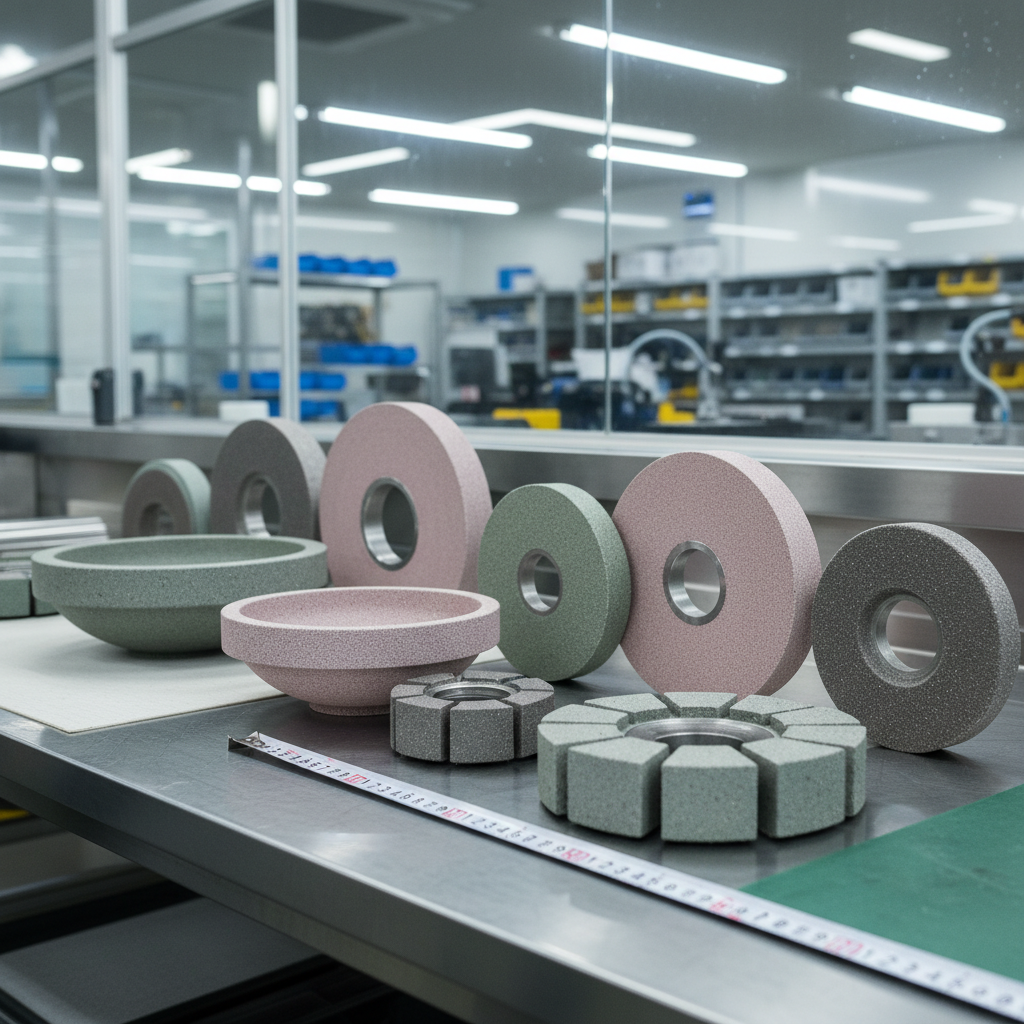
And then there’s the geometry problem. Non-standard diameters, unusual bore sizes, step wheels, recessed wheels, cup wheels, dish wheels, segmented wheels with custom block counts and arrangements. None of these show up in a standard catalog. You either order custom or you don’t get the job done right.
The 5 Key Parameters You Need to Specify
Every grinding wheel is defined by five core characteristics. Miss any one of them in your order and the manufacturer has to guess. Here’s what they are and why each one matters.
1. Abrasive Type
This is the material that actually does the cutting. The most common options are:
- WA (White Aluminum Oxide) – Good for hardened steels, tool steels, and where heat sensitivity matters. It fractures cleanly and stays sharp.
- A (Brown Aluminum Oxide) – Tougher than WA. Used for carbon steels, forgings, and general-purpose grinding where durability matters more than cool cutting.
- GC (Green Silicon Carbide) – Harder than aluminum oxide. Used for cast iron, non-ferrous metals, ceramics, and cemented carbides.
- CBN (Cubic Boron Nitride) – Second hardest abrasive after diamond. Excellent for hardened steels, superalloys, and high-precision work. CBN grinding wheels are becoming the standard in modern tool rooms for good reason.
- D (Diamond) – Hardest abrasive. Used for carbides, ceramics, glass, and other non-ferrous materials. Not for steel.
Picking the wrong abrasive is probably the most expensive mistake in custom wheel ordering. Diamond on steel will carbonize and destroy the wheel. Aluminum oxide on silicon carbide workpieces won’t cut efficiently. Get this right first.
2. Grit Size
Grit size controls the relationship between material removal rate and surface finish. Coarse grits (24-36) remove material fast but leave a rough surface. Medium grits (46-80) are the workhorses for most production grinding. Fine grits (100-220) give mirror finishes but cut slowly. The grit number corresponds to the mesh size of the screen the abrasive particles pass through. So a 60 grit wheel has abrasive grains that pass through a 60-mesh screen but not through an 80-mesh screen.
In practice, grit selection depends on your stock removal, your required Ra (surface roughness), and the material hardness. Harder materials often need coarser grits because fine grits glaze over. Softer materials can use finer grits for better finishes without burning.
3. Grade (Hardness)
The grade letter indicates how strongly the bond holds the abrasive grains. It runs from A (very soft) to Z (very hard), with most production work falling between G and P. A soft wheel releases grains quickly, which keeps the wheel cutting freely but wears faster. A hard wheel holds grains longer, which is good for form holding and long life, but it can load up and burn the workpiece if the bond is too hard for the application.
The relationship between grade and workpiece material is the opposite of what most people assume. Hard materials like hardened tool steel need softer grade wheels because the grains dull quickly and need to release. Soft materials like mild steel can use harder grades because the grains stay sharp longer. This is one of the most counterintuitive aspects of abrasive specification, and getting it wrong leads to burns, poor finishes, and short wheel life.
4. Structure (Porosity)
Grinding wheel structure controls the spacing between abrasive grains. It’s numbered from 0 (very dense, almost no pores) to 20 (very open, lots of space between grains). Most wheels fall between structure 5 and 9. Dense structures (5-6) give good form holding and fine finishes on hard materials. Open structures (8-12) are better for soft materials, heavy stock removal, and situations where chip clearance matters. The grinding wheel structure in real production is often the variable that separates a wheel that works from one that doesn’t, and many machinists overlook it.
For custom orders, you can also specify special porosity structures. Some manufacturers offer honeycomb porosity for improved coolant flow, or induced porosity for specific chip evacuation needs. These aren’t available in catalog wheels and require custom manufacturing.
5. Bond Type
The bond holds the abrasive grains together and gives the wheel its structural integrity. Three types dominate:
- Vitrified Bond (V) – Made from fired clay and glass. Rigid, porous, excellent for precision grinding. Can be dressed with single-point diamond dressers. The most common bond for surface, cylindrical, and tool grinding. For precision steel grinding, vitrified bond CBN wheels are often the best choice.
- Resinoid Bond (B) – Made from synthetic resin. More flexible than vitrified, good for high-speed operations, cut-off wheels, and applications where some wheel compliance helps. Self-sharpening to some degree.
- Metal Bond (M) – Made from sintered metal (bronze, cobalt, etc.). Very long life, used primarily for diamond wheels on carbides and ceramics. Hard to dress, but extremely durable.
| Abrasive | Code | 最适合 | Not For | Relative Cost |
|---|---|---|---|---|
| Brown Aluminum Oxide | A | Carbon steel, forgings, general purpose | Hardened steel, carbide | Low |
| White Aluminum Oxide | WA | Hardened steel, tool steel, HSS | Carbide, non-ferrous | Low-Medium |
| Green Silicon Carbide | GC | Cast iron, ceramics, cemented carbide | Steel (too friable) | Low-Medium |
| Cubic Boron Nitride | CBN | Hardened steel, superalloys, HSS | Non-ferrous, soft aluminum | High |
| 钻石 | D / SD | Carbide, PCD, ceramics, glass | Steel (carbonizes) | High |
Other bonds exist (shellac, rubber, electroplated), but for most custom orders you’ll be choosing between these three.
How to Read and Write a Grinding Wheel Specification Code
A complete grinding wheel specification is written as a string of codes. The format follows ISO or ANSI standards, and once you know the structure, it tells you everything about the wheel in one line. Here’s a typical example:
1A1 350x40x127 WA 60 K V
Let’s break that down piece by piece:
- 1A1 – Wheel shape code. 1A1 is a straight wheel (flat, no recesses). Other common shapes include 6A2 (cup wheel), 11V9 (dish wheel), 12A2 (taper cup), and 1EE1 (double recessed).
- 350x40x127 – Dimensions in millimeters: Outside Diameter x Thickness x Bore (arbor hole). So this wheel is 350mm OD, 40mm thick, with a 127mm bore.
- WA – Abrasive type: White Aluminum Oxide.
- 60 – Grit size: 60 grit (medium).
- K – Grade: K is medium-hard on the A-Z scale. One step softer than L, one step harder than J.
- V – Bond type: Vitrified.
- Standard vitrified aluminum oxide: 2-4 weeks
- Custom dimensions, standard abrasives: 3-5 weeks
- CBN or diamond wheels: 4-8 weeks depending on size and complexity
- Segmented or specialty bond wheels: 5-10 weeks
- Dimensions – Measure the outside diameter, thickness, and bore with calipers. Verify they match your order specification within the stated tolerance (typically ±0.5mm for OD and thickness, ±0.025mm for bore on precision wheels).
- Visual inspection – Check for cracks, chips, uneven color (which can indicate inconsistent mixing), and surface defects. Tap the wheel lightly with a wooden handle. A vitrified wheel should ring clear. A dull thud suggests internal cracks. Do not use a cracked wheel.
- Marking – Verify the wheel label matches your specification. The label should show the abrasive type, grit size, grade, bond, and maximum operating speed. If anything doesn’t match, stop and contact the manufacturer.
- Hardness check (optional) – Some shops use a scleroscope or manual scratch test to verify the grade is correct. This matters most when you’ve ordered a specific grade for burn-sensitive applications.
- Balance – For high-speed grinding (above 35 m/s), have the wheel statically or dynamically balanced before use. Custom wheels should arrive balanced, but verify. An unbalanced wheel at high speed is dangerous.
- Machine make and model
- Wheel shape code (or send a drawing for non-standard shapes)
- Dimensions: OD x Thickness x Bore, with tolerances
- Abrasive type (WA, A, GC, CBN, D, etc.)
- Grit size
- Grade (hardness letter)
- Structure number (if applicable)
- Bond type (V, B, M, etc.)
- Maximum operating speed (in m/s or RPM)
- Workpiece material and hardness
- Required surface finish (Ra value, if known)
- Coolant type (water-based, oil, dry, MQL)
- Quantity needed
- Any special features: coolant holes, keyways, recesses, step profiles
- 电子邮件: root@shalun.net
- Phone / WeChat: 15538050608
- 电话: 0371-62513386
- 地址: No. 1111-1, Kexue Avenue, Shangjie District, Zhengzhou, Henan, China
Sometimes a structure number is inserted between the grade and bond, like WA 60 K 7 V, where 7 is the structure number. Not all manufacturers include this by default, so if porosity matters for your application, specify it explicitly. Don’t assume.
For CBN grinding wheels or diamond wheels, the abrasive code changes. CBN is typically written as CBN or CB, and diamond as D or SD (synthetic diamond). A CBN wheel spec might look like 1A1 150x20x31.75 CBN 120 M 75 V, where 120 is the grit, M is the grade, 75 is the concentration (diamond/CBN wheels use concentration instead of structure), and V is the bond.
When you order a custom grinding wheel, write out the full specification. Don’t write “350mm white wheel” and expect the manufacturer to figure out the rest. Include the shape code, all three dimensions, abrasive type, grit size, grade, structure (if relevant), bond type, and any special requirements like maximum operating speed or coolant hole pattern.
Common Custom Wheel Orders
Custom manufacturing covers a wide range of situations. Here are the most common types of custom orders we see:
Non-Standard Dimensions
A customer has a machine with a 270mm wheel guard clearance but needs the widest possible face. The standard catalog offers 250mm and 300mm, nothing in between. A custom 270x32x76.2 wheel solves this. Or a customer needs a 400mm wheel but their machine only accepts a 50mm bore instead of the standard 127mm or 203.2mm. These are straightforward custom orders for any competent manufacturer.
Special Bore Sizes and Keyways
European and Japanese machines often use bore sizes that don’t match ANSI standards. A Studer S33 might need a 31.75mm bore, while a German Junker needs 40mm with a keyway. North American machines commonly use 1.25 inch (31.75mm), 3 inch (76.2mm), 5 inch (127mm), or 8 inch (203.2mm). Always specify bore diameter, tolerance, and whether a keyway, slot, or pin hole is needed.
Segmented Wheels
Large surface grinders, creep feed grinders, and some cylindrical grinders use segmented wheels instead of monolithic ones. Segments can be custom-made in different abrasive types, different grits, and different bond systems. The segments bolt or glue onto a wheel body. Custom segment orders need to specify the number of segments, the segment dimensions (length, width, height), the abrasive/bond combination, and the segment geometry (straight, angled, or stepped).
CBN and Diamond Wheels for Special Applications
CBN and diamond wheels are almost always custom-ordered because the optimal specification depends heavily on the specific application. A CBN wheel for grinding HSS taps requires different grit, grade, and concentration than a CBN wheel for grinding automotive camshafts. Diamond wheels for PCD tool grinding need different specs than diamond wheels for ceramic bearing races. Custom CBN/diamond wheel orders should include the workpiece material, hardness, machine type, desired finish, and coolant type at minimum.
Lead Time and MOQ Considerations
Here’s the reality of custom wheel manufacturing: it takes time. Typical lead times for custom grinding wheels are:
Minimum order quantities vary by manufacturer. Some will make a single custom wheel for a prototyping order, but the per-unit cost will be higher because setup costs get spread over fewer pieces. Ordering 5-10 wheels typically brings the unit price down significantly. For production runs of 20+ wheels, most manufacturers offer their best pricing. If you’re ordering for a new machine installation, consider ordering a stock of replacement wheels at the same time to save on both manufacturing and shipping costs.
Rush orders are sometimes possible, but they come at a premium and may limit the manufacturer’s ability to do thorough quality checks. Plan ahead when you can. The money you save by ordering early is real, and so is the quality assurance that comes from not rushing.
Quality Verification: How to Check What You Got
When a custom grinding wheel arrives, don’t just mount it and start grinding. Verify it first. Here’s what to check:
After wheel dressing, run a test piece and check your surface finish against the expected Ra. If the wheel is cutting too aggressively or too gently, you may need to adjust your dressing parameters before blaming the wheel specification. But if it consistently burns, loads, or produces poor finishes after proper dressing, the specification might not match your application. Talk to your manufacturer about what’s happening. A good manufacturer will help you troubleshoot and adjust the spec for your next order.
Putting Your Specification Together
When you’re ready to order grinding wheel products with custom specifications, gather the following information before you contact the manufacturer:
The more information you provide upfront, the fewer rounds of back-and-forth with the engineering team, and the faster your wheels arrive. Manufacturers appreciate detailed specs because it reduces ambiguity and the chance of errors.
Custom wheel manufacturing doesn’t have to be complicated or risky. With the right specification data and a reliable manufacturer, you can get exactly the wheel you need for your specific grinding operation. The key is understanding what each parameter does and communicating it clearly.
Need a Custom Grinding Wheel? Get in Touch
郑州众信砂轮有限公司 (Zhengzhou Zhongxin Grinding Wheel Co., Ltd.) has been manufacturing custom grinding wheels for customers worldwide for years. Whether you need a standard specification in a non-standard size, a specialized CBN or diamond wheel for a difficult application, or help figuring out the right specification for a new grinding project, their engineering team can help.
Send your specification, drawing, or even just the machine model and material you’re grinding. They’ll recommend the right wheel and provide a quote with realistic lead times. Custom orders are their specialty, and they understand that in production grinding, the right wheel makes all the difference.