


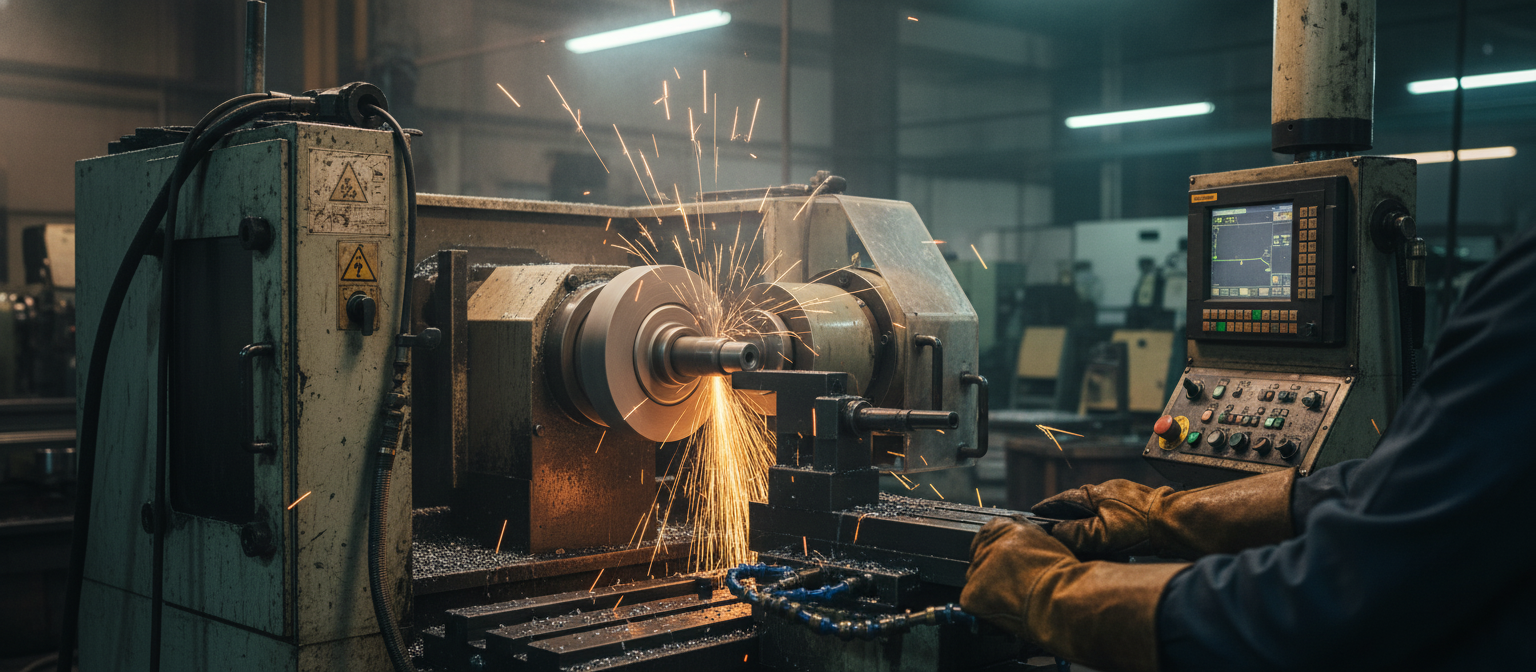
Creep-Feed Grinding Waspaloy: How Open-Structure Wheels Prevent Thermal Damage
In the aerospace and power generation industries, Waspaloy is highly valued for its exceptional strength, corrosion resistance, and stability at temperatures reaching up to 870°C (1600°F). However, the very characteristics that make this nickel-based superalloy indispensable for turbine blades, shafts, and compressor discs also make it a nightmare to machine. Waspaloy’s low thermal conductivity, high work-hardening rate, and extreme abrasiveness create intense thermal and mechanical stresses during material removal.
For high-efficiency profiling, creep-feed grinding (CFG) is the preferred method because of its high material removal rates (MRR) and ability to generate complex geometries in a single pass. Yet, the long contact arc inherent to creep-feed grinding dramatically increases the risk of thermal damage, commonly known as grinding burn. To mitigate this risk, process engineers must look beyond conventional grinding wheels and adopt engineered open-structure grinding wheels. This article explores the technical mechanics of creep-feed grinding Waspaloy and explains how open-structure wheel technology acts as the ultimate defense against thermal damage.
The Metallurgy of Waspaloy and the Threat of Grinding Burn
Waspaloy is a precipitation-hardened, nickel-based superalloy alloyed with cobalt, chromium, molybdenum, titanium, and aluminum. Its microstructure consists of a highly stable gamma prime (γ’) FCC matrix, which resists plastic deformation even under extreme heat. When grinding Waspaloy, two major metallurgical characteristics work against the cutting tool:
- Low Thermal Conductivity: Waspaloy’s thermal conductivity is roughly 11 W/m·K at room temperature—less than one-fourth that of typical carbon steels. During grinding, the heat generated by friction and plastic deformation cannot dissipate quickly through the workpiece. Instead, it concentrates directly at the grinding zone.
- Extreme Work Hardening: Under mechanical shear, Waspaloy work-hardens instantaneously. If an abrasive grain is dull or glazed, it plows and rubs the material rather than cutting it clean. This plowing action increases the specific grinding energy and generates massive frictional heat, accelerating the work-hardening cycle.
Without adequate thermal control, this heat concentration leads to severe surface integrity issues, including grinding burn. In Waspaloy, thermal damage manifests as tensile residual stresses (which drastically reduce fatigue life), micro-cracking, depletion of the gamma-prime strengthening phase, and localized phase transformations (the formation of a brittle “white layer”). For critical aerospace components, such defects result in immediate scrap.
The Creep-Feed Grinding Paradox
Creep-feed grinding operates on a distinct kinematic principle: a very deep radial depth of cut ($a_e$, up to several millimeters) combined with a slow workpiece feed rate ($v_w$). This kinematics creates a long contact arc length ($l_c$), which can be calculated using the simplified formula:
$$l_c \approx \sqrt{a_e \cdot d_s}$$
Where $d_s$ is the grinding wheel diameter. Because $l_c$ is exceptionally long, a single abrasive grain remains engaged in the cut for a prolonged duration. This creates two critical challenges:
- Coolant Starvation: The high rotational speed of the wheel creates a boundary layer of high-pressure air around its periphery. This aerodynamic barrier prevents conventional grinding fluids from entering the long, narrow contact zone, leading to “coolant starvation” right at the point of highest heat generation.
- Wheel Loading: The ductile, sticky chips of Waspaloy have nowhere to go. In a standard, dense grinding wheel, the tiny pores between abrasive grains quickly fill with metal chips. This phenomenon, known as wheel loading, transforms the abrasive surface into a metallic bond, causing extreme friction, high normal forces, and catastrophic thermal burn. To understand how to combat this, engineers can refer to our 2026 Guide to Preventing Loading in High-MRR Nickel Alloy Applications.
How Open-Structure Wheels Prevent Thermal Damage
To overcome the creep-feed grinding paradox, the grinding wheel must be engineered with an “open-structure” (highly porous) design. Unlike standard wheels, which rely on natural packing density, open-structure wheels are manufactured using specialized pore-forming agents (such as naphthalene, PMMA beads, or advanced bubble alumina) that burn out during the vitrification process, leaving behind a network of large, interconnected, and highly uniform pores.
1. Interconnected Pores as Coolant Reservoirs
The large, open pores of an open-structure wheel act as micro-reservoirs. As the wheel rotates, these pores scoop up coolant from the external nozzles and carry it directly through the high-pressure air barrier. Once inside the long contact arc, the centrifugal force and mechanical compression squeeze the coolant out of the pores directly onto the active grinding zone. This continuous, internal lubrication and cooling drastically reduce the temperature at the grinding arc, preventing the thermal spikes that cause grinding burn. For more on managing the thermal dynamics of grinding, see our guide on Troubleshooting Grinding Burns and Fixing Glazing.
2. Deep Chip Pockets to Combat Loading
In Waspaloy grinding, chip clearance is vital. The open-structure design provides large, dedicated “pockets” surrounding each abrasive grain. As the grain shears the nickel superalloy, the long, ductile chip curls and settles into the adjacent pore space without being compressed against the workpiece. As the wheel exits the grinding zone, the combination of high-pressure coolant flushing and centrifugal force easily ejects the chips, keeping the wheel clean, sharp, and free of loaded metal.
3. Lowering Specific Grinding Energy
Specific grinding energy ($e_c$) is the energy required to remove a unit volume of material. When a wheel glazes or loads, $e_c$ spikes because the energy is spent on friction rather than chip formation. Open-structure wheels maintain a high ratio of cutting-to-sliding because the grains remain exposed and sharp. By keeping $e_c$ low, the total heat generated during the cut is minimized. You can explore the relationship between forces and wheel structures in our technical analysis on Optimizing Specific Grinding Energy Using Open-Structure Wheels.
Designing the Ideal Open-Structure Wheel for Waspaloy
Successfully creep-feed grinding Waspaloy requires a precise combination of abrasive grain, bond type, hardness grade, and structure number. Below are the engineering specifications recommended by Zhengzhou Zhongxin Grinding Wheel Co., Ltd. for this high-demand application:
| Wheel Parameter | Recommended Specification | Engineering Rationale |
|---|---|---|
| Abrasive Type | Microcrystalline Ceramic Alumina (SG) or CBN | Ceramic alumina offers micro-fracturing self-sharpening; CBN provides ultra-high thermal conductivity to pull heat away from the workpiece. |
| Grit Size | 46 to 80 Mesh | Coarser grits (46–60) maximize chip clearance; finer grits (80) are used for tight radii and complex profile retention. |
| Grade (Hardness) | F to I (Soft) | A soft grade ensures the bond releases dull grains easily, preventing glazing and work-hardening of the Waspaloy surface. |
| Structure Number | 12 to 18 (Very Open) | High structure numbers indicate a highly porous, open-pore volume (up to 55% to 65%) to ensure maximum chip clearance and coolant transport. |
| Bond Type | High-Performance Vitrified (V) | Vitrified bonds provide the structural rigidity required for profile accuracy while allowing the integration of highly interconnected, artificial pore networks. |
Coolant Dynamics: Matching Jet Velocity and Breaking the Air Boundary Layer
In creep-feed grinding Waspaloy, the application of coolant is just as critical as the wheel design itself. Because the wheel rotates at high peripheral speeds ($v_s$ typically between 25 m/s and 45 m/s), it drags a turbulent boundary layer of air along its outer diameter. This air barrier acts as a pneumatic shield, deflecting low-pressure coolant away from the grinding zone. If the coolant cannot penetrate this barrier, the open-pore structure of the wheel remains dry, rendering its micro-reservoirs useless.
To overcome this, the coolant delivery system must be engineered according to three primary variables: nozzle design, fluid velocity, and flow rate.
Jet Velocity Matching
The fundamental rule of high-performance grinding fluid delivery is that the coolant jet velocity ($v_j$) must match or slightly exceed the wheel peripheral speed ($v_s$). If $v_j < v_s$, the boundary layer will push the coolant away. If $v_j \approx v_s$, the coolant stream cuts through the air barrier and enters the pore structure smoothly, minimizing turbulence and air entrainment. Jet velocity can be calculated using the nozzle pressure ($P$) and fluid density ($\rho$) via the Bernoulli equation:
$$v_j = C_d \sqrt{\frac{2P}{\rho}}$$
Where $C_d$ is the discharge coefficient of the nozzle (typically 0.85 to 0.95 for high-quality coherent nozzles). For a wheel speed of 35 m/s, the required coolant pressure for water-based fluids is approximately 8 to 12 bar (116 to 174 psi). For neat oils, which have higher viscosity and density, pressures of 15 to 25 bar (217 to 362 psi) may be necessary to maintain a coherent, non-turbulent stream.
Coherent Jet Nozzles
Standard flat or round pipe nozzles produce highly divergent, turbulent sprays that entrain air and lose velocity rapidly. For creep-feed grinding Waspaloy, engineers must use CNC-designed coherent jet nozzles. These nozzles feature internal laminating profiles that produce a solid, glass-like stream of fluid that remains coherent over a long distance, ensuring that maximum kinetic energy is delivered directly to the grinding nip.
Flow Rate Requirements
The flow rate ($Q$) must be sufficient to carry away the heat generated by the grinding process. A reliable rule of thumb for creep-feed grinding nickel alloys is to supply 1.5 to 2.0 liters per minute (L/min) per millimeter of wheel width for every kilowatt (kW) of spindle power consumed during the cut. For example, if a profiling operation on a 50 mm wide Waspaloy blade consumes 20 kW of grinding power, the target coolant flow rate should be:
$$\text{Flow Rate} = 50\text{ mm} \times 20\text{ kW} \times 1.5 \approx 150\text{ L/min}$$
Dressing Parameters: Maintaining the Open-Pore Topology
Dressing is the process of conditioning the grinding wheel to restore its geometric profile and sharpen the abrasive grains. However, when working with highly porous, open-structure wheels, improper dressing parameters can easily crush the vitrified bond bridges, close up the engineered pores, or dull the abrasive grains before they ever touch the Waspaloy workpiece.
To maintain the high-porosity structure, rotary diamond dressing rolls are preferred over single-point stationary diamonds. Rotary dressing allows for precise control over the wheel topography through the speed ratio ($q_d$), which is defined as:
$$q_d = \frac{v_r}{v_s}$$
Where $v_r$ is the peripheral speed of the dressing roll, and $v_s$ is the peripheral speed of the grinding wheel. The direction of rotation and the speed ratio determine the aggressive nature of the dress:
- Unidirectional Dressing (Co-current, $+q_d$): The dressing roll and grinding wheel rotate in the same direction at the contact zone. This contact produces low relative speeds, resulting in a gentle crushing action that opens up the wheel structure and leaves the abrasive grains highly fractured and sharp. A speed ratio of $+0.4$ to $+0.8$ is ideal for maintaining a high-MRR, open wheel topology.
- Counter-directional Dressing (Counter-current, $-q_d$): The roll and wheel rotate in opposite directions at the contact zone. This creates high relative speeds, which tend to shear and dull the abrasive grains, closing the wheel’s surface pores. While this is useful for achieving fine surface finishes on steels, it is highly detrimental for creep-feed grinding Waspaloy, as it increases the risk of immediate thermal burn.
Dressing Depth of Cut and Cross-Feed Rates
For vitrified ceramic wheels, the radial dressing depth of cut ($a_d$) should be kept minimal to preserve wheel life and maintain sharp cutting edges. A dressing depth of 1 to 3 microns per pass is typical. The dressing lead ($f_d$), or cross-feed rate, must be carefully balanced. A fast cross-feed rate creates a coarser, more open wheel face, which is excellent for creep-feed grinding because it reduces grinding forces. Conversely, a slow cross-feed creates a smooth wheel face that increases friction and thermal load.
Kinematics and Optimization of Creep-Feed Grinding Waspaloy
When setting up a creep-feed grinding process for Waspaloy, engineers must balance the material removal rate ($Q’_w$) with the thermal limits of the workpiece. The specific material removal rate is calculated as:
$$Q’_w = a_e \cdot v_w$$
Where $a_e$ is the radial depth of cut (mm) and $v_w$ is the workpiece feed rate (mm/min). In creep-feed grinding, $a_e$ is set very high (typically 1.0 to 10.0 mm), while $v_w$ is kept low (typically 50 to 300 mm/min). This kinematic combination yields a high $Q’_w$ while distributing the wear across a larger volume of the grinding wheel.
However, as $a_e$ increases, the contact length ($l_c$) increases, which raises the total normal and tangential grinding forces. To prevent thermal damage, engineers must monitor the specific grinding energy ($e_c$) and the force ratio ($\mu = F_t / F_n$). A sudden drop in the force ratio or an exponential increase in spindle power indicates that the wheel has glazed or loaded. In such cases, the feed rate should be reduced, or the dressing frequency must be adjusted.
Case Study: Creep-Feed Grinding Waspaloy Turbine Blade Roots
To demonstrate the effectiveness of engineered open-structure wheels, Zhengzhou Zhongxin Grinding Wheel Co., Ltd. conducted a comparative study in an aerospace manufacturing facility. The operation involved grinding the highly complex fir-tree root profile on Waspaloy turbine blades.
The baseline process utilized a standard vitrified microcrystalline alumina wheel with a structure number of 8 (medium density). The optimized process utilized a Zhengzhou Zhongxin SG-Vitrified wheel with an induced open structure (Structure 16). Both tests were run under identical machine setups:
- Workpiece Material: Waspaloy (Precipitation Hardened, 42 HRC)
- Wheel Speed ($v_s$): 30 m/s
- Depth of Cut ($a_e$): 3.5 mm
- Workpiece Feed Rate ($v_w$): 120 mm/min
- Coolant: 10% water-soluble synthetic oil delivered at 12 bar via coherent jet nozzles
Results and Analysis
The standard wheel (Structure 8) showed signs of metal loading after grinding just two blade profiles. By the third blade, the spindle load spiked by 35%, and metallurgical inspection revealed localized grinding burn (visible temper colors and a 5-micron thick white layer with tensile residual stresses exceeding +400 MPa).
In contrast, the Zhengzhou Zhongxin Structure 16 open-pore wheel completed 15 blades before requiring a dressing cycle. Spindle load remained completely stable throughout the run. Most importantly, X-ray diffraction analysis of the ground surfaces showed compressive residual stresses (-250 to -400 MPa) and zero phase transformations or micro-cracking. The interconnected pores effectively transported enough coolant to keep the grinding zone temperature below the critical phase change threshold of Waspaloy.
Conclusion
Creep-feed grinding Waspaloy represents one of the most demanding material-removal challenges in modern manufacturing. The low thermal conductivity and rapid work-hardening nature of this nickel-based superalloy demand a grinding system that minimizes friction, maximizes chip evacuation, and guarantees continuous coolant delivery directly into the cutting zone.
Engineered open-structure vitrified wheels provide the ultimate solution to this engineering challenge. By utilizing high structure numbers (12 to 18) and microcrystalline ceramic grains, these wheels act as active cooling delivery systems and chip-evacuating tools. When combined with optimized coherent jet coolant systems and precise rotary dressing parameters, open-structure wheels eliminate the risk of grinding burn, dramatically extend wheel life, and ensure the absolute surface integrity of critical aerospace and power generation components.
At Zhengzhou Zhongxin Grinding Wheel Co., Ltd., we specialize in custom-formulating high-performance, open-structure vitrified and CBN grinding wheels tailored specifically for difficult-to-machine superalloys like Waspaloy, Inconel, and Rene. Our technical engineering team is ready to help you optimize your creep-feed grinding processes, eliminate thermal defects, and boost your production throughput.
To discuss your specific application requirements, request a technical consultation, or receive a custom quote, please contact our engineering headquarters today:
Zhengzhou Zhongxin Grinding Wheel Co., Ltd.
Phone/WhatsApp: +86 15538050608
Email: root@shalun.net
Address: No. 1111-1, Kexue Avenue, Shangjie District, Zhengzhou, Henan, China.