


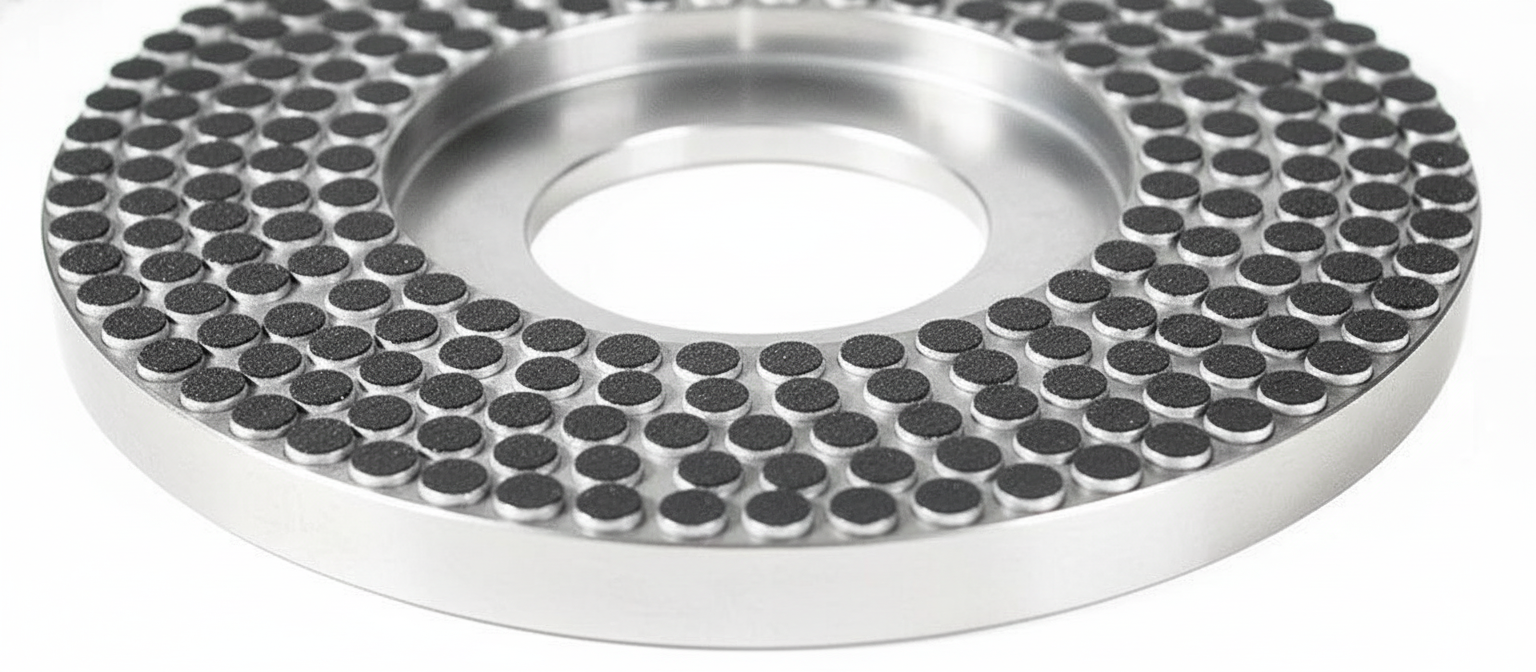
In modern industrial manufacturing, grinding wheels are indispensable tools for precision machining. Among superabrasive options, CBN (Cubic Boron Nitride) grinding wheels have emerged as a leading choice for ferrous metal processing, offering distinct advantages over conventional abrasives and even diamond in specific applications. Widely adopted in aerospace, automotive, and die & mold industries, CBN wheels deliver superior thermal stability, chemical inertness against iron-based alloys, and exceptional dimensional accuracy.
This article explores the main types of CBN abrasive grains, the bond systems used in CBN wheel construction, and the key grinding advantages that make CBN the preferred solution for high-precision, high-efficiency machining of hardened steels and superalloys.
1. Types of CBN Abrasive Grains
CBN abrasive grains are available in two primary crystal structures — monocrystalline and polycrystalline — each suited to different grinding conditions and workpiece materials.
1.1 Monocrystalline CBN
Monocrystalline CBN grains consist of a single, continuous crystal lattice. This structure provides exceptionally high hardness and compressive strength, resulting in sharp, well-defined cutting edges that maintain their geometry throughout the grinding process.
- Characteristics: High hardness, strong fracture resistance, long wheel life, and consistent cutting performance.
- Best suited for: Grinding hardened steels (HRC 58–67), high-speed steel (HSS), tool steels (D2, M2), and other materials requiring high stock removal rates with tight tolerances.
1.2 Polycrystalline CBN
Polycrystalline CBN (PCBN) grains are composed of multiple CBN crystal particles sintered together. The micro-fracture behavior of the multi-grain structure creates new cutting edges during grinding, providing a self-sharpening effect that is particularly advantageous for demanding applications.
- Characteristics: Self-sharpening through controlled micro-fracture, uniform cutting forces, and excellent surface finish generation.
- Best suited for: Complex-profile grinding, precision finishing operations, and applications where consistent surface quality is critical — such as automotive camshaft and crankshaft grinding.
2. CBN Wheel Bond Systems
The bond system holds the CBN abrasive grains in place and largely determines the wheel’s performance characteristics, including cutting ability, wheel life, and dressability. Four bond types are commonly used for CBN wheels:
2.1 Vitrified Bond CBN Wheels
Vitrified (ceramic) bond CBN wheels are the most widely used type in precision grinding. The glass-ceramic bond matrix offers an ideal balance of strength, porosity, and thermal resistance.
- Advantages: High material removal rates without thermal damage, excellent dressability for precise profile maintenance, open porosity for effective chip evacuation and coolant penetration, and high geometric accuracy.
- Applications: High-speed grinding of stainless steel, alloy steel, and bearing steel. Common in automotive component manufacturing, air conditioning compressor production, and bearing grinding.
2.2 Metal Bond CBN Wheels
Metal bond CBN wheels use a sintered metal matrix (typically bronze or steel) to hold the abrasive grains. This produces a very rigid, wear-resistant wheel capable of withstanding high grinding pressures and impact loads.
- Advantages: Exceptional bond strength, high rigidity under heavy loads, long service life, and excellent form-holding capability.
- Applications: Grinding high-vanadium HSS, aluminum HSS, and other tough, high-hardness alloys where aggressive stock removal is required.
2.3 Resin Bond CBN Wheels
Resin bond CBN wheels use a thermosetting resin matrix that provides inherent elasticity to the wheel structure. This elasticity allows the wheel to conform slightly to the workpiece surface during grinding, improving contact and surface finish quality.
- Advantages: Good self-dressing properties, elastic conformity to workpiece contours, excellent surface finish, lower manufacturing cost, and suitability for small-batch and multi-variety production.
- Note: The resin bond’s elasticity causes micro-deformation under grinding pressure, which helps abrasive grains self-adjust their cutting angles for more uniform material removal.
2.4 Electroplated CBN Wheels
Electroplated CBN wheels feature a single layer of CBN grains permanently bonded to a metal substrate via nickel electroplating. This construction provides maximum grain exposure, resulting in extremely aggressive cutting action.
- Advantages: Uniform grain distribution, very sharp cutting edges, high hardness and wear resistance, minimal dressing requirements, and long operational life per wheel.
- Applications: Ideal for profile grinding, form grinding, and applications requiring complex wheel geometries where the single-layer design allows intricate shape formation.
3. Key Characteristics of CBN Grinding Wheels
The exceptional performance of CBN grinding wheels stems from three fundamental material properties:
3.1 Extreme Hardness and Wear Resistance
CBN ranks second only to diamond on the Mohs hardness scale (~9.5), enabling it to efficiently machine virtually all hardened ferrous materials. This extreme hardness translates directly into long wheel life and consistent cutting performance over extended production runs, significantly reducing per-part grinding costs.
3.2 Superior Thermal Stability
CBN maintains its hardness and cutting ability at temperatures up to 1,400°C — well above the thermal degradation threshold of diamond (~800°C in the presence of ferrous catalysts). This makes CBN the only practical superabrasive for high-speed and dry grinding of steel, where grinding zone temperatures routinely exceed 700°C.
3.3 Chemical Inertness Against Ferrous Metals
Unlike diamond, which undergoes graphitization and accelerated wear when in contact with iron-group elements at elevated temperatures, CBN is chemically inert to ferrous metals. This fundamental advantage eliminates the rapid bond degradation that limits diamond wheel life in steel grinding applications.
4. Grinding Advantages of CBN Wheels
These material properties translate into practical grinding advantages that benefit both productivity and part quality:
- High material removal rates: CBN wheels support aggressive cutting parameters — higher wheel speeds, deeper cuts, and faster traverse rates — enabling significantly shorter cycle times compared to conventional aluminum oxide wheels.
- Precision and consistency: The thermal and dimensional stability of CBN wheels ensures minimal wheel wear during grinding, maintaining tight geometric tolerances and consistent surface finish quality throughout long production runs.
- Extended wheel life: CBN wheels typically last 50–200× longer than conventional abrasive wheels when grinding hardened steels, dramatically reducing wheel changeover frequency and associated downtime.
- Reduced thermal damage: The superior heat dissipation characteristics of vitrified CBN wheels — combined with their ability to maintain sharp cutting edges — minimize the risk of grinding burns, metallurgical damage, and residual tensile stresses in the workpiece.
- Broad material compatibility: CBN wheels are effective across a wide range of ferrous materials including hardened carbon steel, tool steel, stainless steel, bearing steel, cast iron, nickel-based superalloys (Inconel, Waspaloy), and powder metallurgy components.
结论
CBN grinding wheels represent a significant advancement in precision grinding technology. Their unique combination of extreme hardness, thermal stability, and chemical inertness against ferrous metals makes them the superior choice for modern high-speed, high-precision grinding operations. As grinding technology continues to evolve — with advances in wheel bond formulations, machine tool rigidity, and coolant delivery systems — CBN wheels will play an increasingly central role in enabling manufacturers to achieve tighter tolerances, better surface finishes, and higher productivity across an expanding range of applications.
For technical consultation on CBN grinding wheel selection or custom specifications, contact Zhengzhou Zhongxin Grinding Wheel Co., Ltd.: root@shalun.net | Tel: 0371-62513386 | Mobile/WeChat: 15538050608