


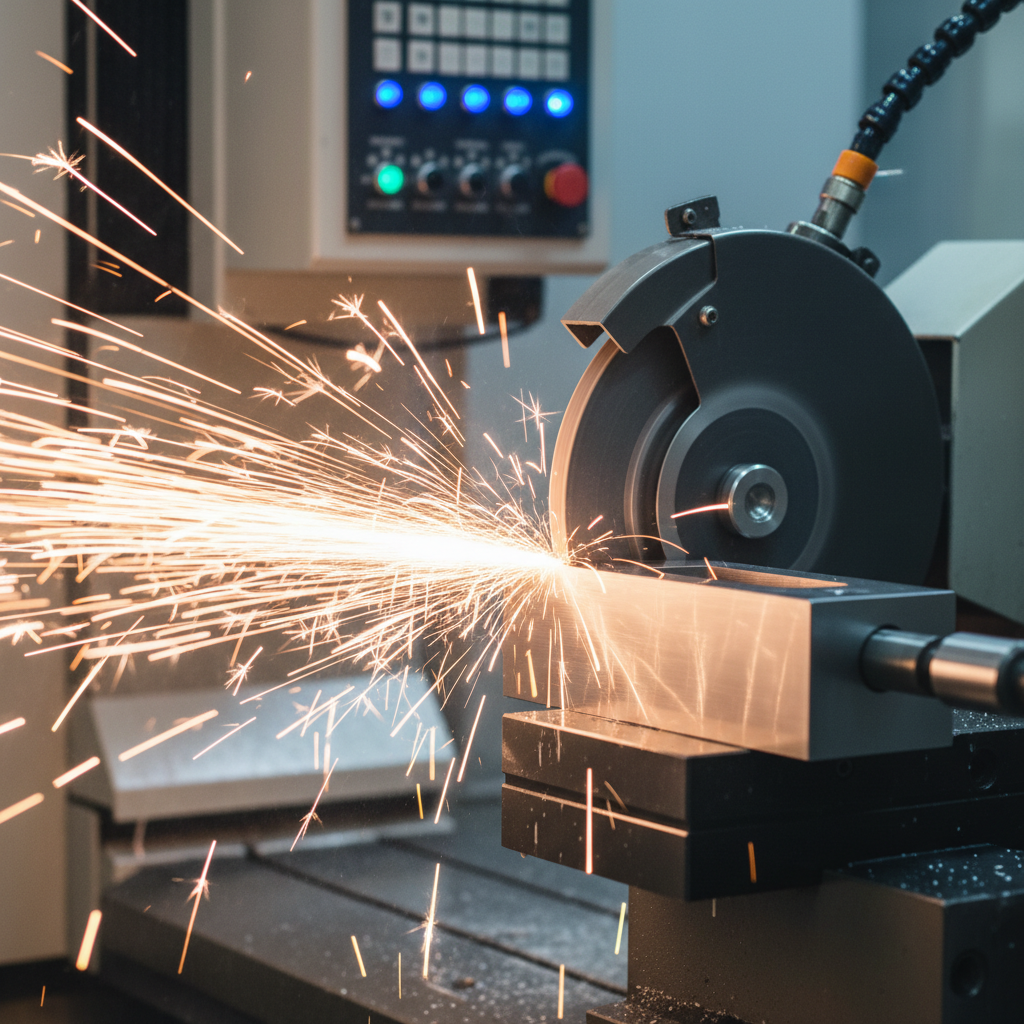
A cracked carbide die costs thousands. Not because of the raw material, but because nobody caught the subsurface damage until it failed in production. Tungsten carbide doesn’t forgive sloppy grinding. At 1400 to 1800 HV, it’s brutally hard, but that hardness comes with brittleness. One wrong parameter and you’ve got a network of microcracks hiding beneath a surface that looks perfectly fine to the naked eye.
Surface integrity isn’t just a quality checkbox. It’s the difference between a carbide insert that cuts 10,000 parts and one that chips after 500. And controlling it requires understanding what happens at the material level when diamond meets WC-Co.
What Surface Integrity Means for Tungsten Carbide
Surface integrity describes the condition of a material’s surface and near-surface region after machining. For tungsten carbide (WC-Co), this includes four measurable factors:
- Surface roughness (Ra) quantified by profilometry, typically ranging from Ra 12.5 μm on rough grinds down to Ra 0.025 μm on polished surfaces
- Microcracks lateral and median cracks that propagate into the binder phase and along WC grain boundaries
- Residual stress tensile or compressive stress locked into the near-surface layer, which directly affects fatigue life and crack propagation
- Microstructural changes phase transformations, cobalt binder depletion, or grain pullout caused by excessive thermal input
Here’s the problem. You can measure Ra with a $300 profilometer. But microcracks and residual stress? Those require etching, X-ray diffraction, or specialized NDT methods. Most shops skip these checks entirely, and that’s where failures come from.
Cemented carbide behaves differently from steel during grinding. There’s no ductile chip formation in the traditional sense. Material removal happens through brittle fracture of WC grains and extrusion of the cobalt binder. That fracture mechanism is exactly what makes surface integrity control so critical and so difficult.
How Grinding Parameters Affect Surface Integrity
Three variables dominate surface integrity outcomes in carbide grinding: depth of cut, wheel speed, and workpiece feed rate. Get any one of these wrong and the consequences cascade.
Depth of Cut
This is the big one. Aggressive depth of cut is the fastest way to destroy surface integrity. For finish grinding of tungsten carbide, you want to stay between 0.002 and 0.01 mm per pass. Yes, that’s two to ten microns. Sounds painfully slow. It is. But at 0.02 mm depth, subsurface cracking can extend 5 to 10 times deeper than at 0.005 mm.
Rough grinding allows 0.02 to 0.05 mm depth, but only if you’re leaving sufficient stock for subsequent finishing passes. The roughing pass will generate subsurface damage to a depth of roughly 15 to 30 μm. That damage layer must be completely removed during semi-finish and finish stages.
Wheel Speed and Feed Rate
Peripheral wheel speed for carbide grinding typically ranges from 25 to 35 m/s. Higher speeds reduce individual chip thickness, which sounds good but generates more heat. For carbide, thermal damage manifests differently than in steel. You won’t see burn marks. Instead, you get cobalt binder oxidation and localized stress concentrations that become crack initiation sites.
Workpiece table feed rate controls the overlap ratio between adjacent wheel revolutions. Slower feed means more wheel-workpiece engagement per unit length, improving Ra but increasing heat input. The sweet spot for finish grinding sits around 5 to 15 m/min, adjusted based on wheel width and contact length.
Cross-feed (stepover per stroke) ties it all together. For surface grinding carbide, 0.5 to 2 mm per stroke works for finish passes. Anything above 3 mm and you’re leaving witness marks that require additional polishing to remove.
Diamond Wheel Selection for Carbide Surface Integrity
Diamond is the only abrasive that works on tungsten carbide. CBN reacts with tungsten carbide at grinding temperatures, causing accelerated wheel breakdown and chemical contamination of the workpiece surface. If you’re grinding WC-Co, it’s diamond or nothing. You can learn more about the differences between these abrasives in our comparison of CBN and diamond grinding wheels.
But not all diamond wheels are equal. The bond system determines how the wheel behaves under load, and that directly controls the surface integrity outcome.
Resin Bond Diamond Wheels
Resin bond is the go-to for surface integrity. The elastic nature of the resin matrix provides a micro-cushioning effect. Each diamond grit particle has slight give as it engages the workpiece, reducing impact forces and producing less subsurface damage. Resin bonds are self-dressing, meaning worn grit breaks away to expose fresh cutting edges. This prevents rubbing and heat buildup.
For Ra 0.1 to 0.4 μm, resin bond wheels with 150 to 240 grit diamond are the standard choice. For mirror finishes below Ra 0.1 μm, resin bond with 280 to 600 grit gets you there, often with the final passes combined with lapping compounds.
Vitrified Bond Diamond Wheels
Vitrified bond offers better form-holding than resin, making it suitable for profile grinding and situations where geometric accuracy matters more than absolute surface finish. The bond is more rigid, which means higher grinding forces and slightly more subsurface damage, but it maintains wheel shape over longer production runs. Expect Ra values in the 0.4 to 0.8 μm range with 80 to 120 grit.
Metal Bond Diamond Wheels
Metal bond is the workhorse for aggressive stock removal. It’s the hardest, most durable bond system, but it produces the roughest finish and generates the most subsurface damage. Use it for roughing only. Metal bond wheels with 36 to 60 grit will remove material quickly but will leave a surface that requires extensive finishing. Ra values of 1.6 to 6.3 μm are typical.
The principle is straightforward: soft bonds for hard materials (to maintain free cutting action), hard bonds for soft materials (to prevent grit from being pulled out before it does its job). Since carbide sits at 1400 to 1800 HV, softer bonds like resin always outperform rigid bonds for final surface integrity. For more on wheel selection philosophy, see our guide on grinding wheel selection for modern tool rooms.
The Polishing Progression: From Rough Grind to Mirror Finish
Surface integrity on carbide isn’t achieved in a single step. It’s a progressive removal of damage layers. Each stage removes the damage left by the previous stage, and if you skip a step, the damage from an earlier stage telegraphs through to the final surface.
Here’s a typical four-stage progression:
| Stage | Abrasive / Grit | Target Ra (μm) | Stock Removal | Purpose |
|---|---|---|---|---|
| Rough Grind | Diamond wheel, 36-60# | 3.2 – 12.5 | 0.05 – 0.2 mm | Shape forming, bulk stock removal |
| Semi-Finish | Diamond wheel, 80-120# | 0.4 – 1.6 | 0.01 – 0.03 mm | Remove rough-grind damage layer |
| Finish Grind | Resin diamond, 150-240# | 0.1 – 0.4 | 0.002 – 0.01 mm | Establish final geometry, minimize residual stress |
| Polish / Lap | Resin diamond, 280-600# or loose abrasive | 0.025 – 0.1 | 0.001 – 0.005 mm | Remove subsurface damage, achieve mirror finish |
The critical transition is between semi-finish and finish. This is where residual stress behavior changes. At higher material removal rates, grinding introduces tensile residual stress. As you reduce depth of cut and switch to finer grits with resin bond, the stress profile shifts toward compressive. Compressive residual stress is desirable; it resists crack propagation and extends component life.
For polishing and lapping of carbide, the shift from bound abrasive to loose abrasive often happens at the 280 grit stage and finer. Diamond slurry (1 to 6 μm diamond particles in carrier fluid) on a cast iron lap produces finishes below Ra 0.05 μm. The process is slow. Sometimes agonizingly slow. But there’s no shortcut if the application demands it.
Diamond compound in progressively finer sizes (15 μm, 9 μm, 6 μm, 3 μm, 1 μm) on different lap surfaces (cast iron, tin, ceramic) can bring carbide to true optical-grade mirror finishes. Tool and die shops doing injection mold work know this sequence well.
Detecting and Preventing Subsurface Damage
You can’t fix what you can’t see. And the worst surface integrity problems in carbide grinding are invisible.
Chemical Etching
The most accessible detection method for subsurface damage is chemical etching. Immerse the ground carbide part in Murakami’s reagent (potassium ferricyanide + sodium hydroxide) or a dilute nitric acid solution. The reagent attacks grain boundaries and reveals microcrack networks that are invisible on the as-ground surface. A 10 to 30 second immersion is usually enough. If the etched surface shows a web of cracks, you know the grinding parameters are wrong.
The limitation? Etching is destructive. You can’t etch a finished production part and still use it. So etching works as a process validation tool on test coupons ground under identical conditions, not as an inspection method on the actual workpiece.
Surface Profilometry
Stylus profilometry gives you Ra, Rz, Rq, and other parameters. But Ra alone doesn’t tell the whole story. Two surfaces with identical Ra values can have completely different integrity profiles depending on the grinding conditions that produced them. A surface ground with too much depth of cut might have the same Ra as one ground correctly, but with deeper and wider spacing between peaks. That’s why Rz (maximum height) and the bearing ratio curve (tp) often correlate better with functional performance than Ra.
Optical profilometry (white light interferometry, confocal microscopy) adds a third dimension. You can see the actual topography, identify pitting from grain pullout, and measure individual crack lengths. It’s slower and more expensive, but for critical components like wire drawing dies or precision stamping tools, it’s worth the investment.
Barkhausen Noise and Non-Destructive Methods
Barkhausen noise analysis works on ferromagnetic materials, and since the cobalt binder in WC-Co is ferromagnetic, it’s applicable to cemented carbide. Changes in the Barkhausen noise signal correlate with residual stress state in the binder phase. High signal activity indicates tensile stress. Low activity suggests compressive stress. It’s non-destructive, fast, and suitable for 100% production inspection of carbide components.
But it measures only the binder phase, not the WC grains themselves. So it’s a proxy measurement, not a direct one. Still, for production environments, it catches the worst offenders quickly.
Practical Recommendations and Quick Reference
After working with carbide grinding and polishing applications for years, here’s what consistently delivers good surface integrity outcomes:
| Bond Type | Best For | Typical Ra Range | Surface Integrity Rating | Wheel Life |
|---|---|---|---|---|
| Resin Bond | Finish grinding, polishing | 0.025 – 0.4 μm | Excellent (low subsurface damage) | Moderate |
| Vitrified Bond | Profile grinding, semi-finish | 0.4 – 1.6 μm | Good (moderate damage) | Good |
| Metal Bond | Rough grinding, stock removal | 1.6 – 12.5 μm | Fair (significant damage layer) | Excellent |
- Always finish grind in the same direction. Reversing direction mid-pass leaves inconsistent residual stress patterns.
- Flood coolant is non-negotiable. Carbide doesn’t conduct heat well. Dry grinding guarantees thermal damage, even at conservative parameters.
- Dress the wheel frequently. A loaded diamond wheel rubs instead of cuts, generating heat and tensile residual stress. Resin bond wheels self-dress, but vitrified and metal bonds need programmed dressing cycles.
- Don’t skip grit steps. Jumping from 60 grit to 240 grit means the 240 wheel spends its entire life removing 60-grit damage instead of creating new finish. Progressive stepping is faster in the long run.
- Verify on a test piece first. Grind a sacrificial coupon under the same conditions, etch it, and inspect before committing to a production run on expensive carbide blanks.
One more thing. Wheel specification and grinding parameters are only half the equation. Machine rigidity matters enormously. A surface grinder with worn spindle bearings or table ways introduces vibration that no wheel specification can compensate for. The best diamond wheel in the world will produce a poor surface on a worn-out machine.
Conclusion
Controlling surface integrity in tungsten carbide grinding is about understanding the chain of cause and effect. Wheel bond system determines grinding forces. Grinding forces determine subsurface damage depth. Subsurface damage determines residual stress. And residual stress determines whether your carbide component lasts or fails.
There’s no single setting or magic wheel that solves everything. It takes the right combination of bond type, grit size, grinding parameters, and progressive finishing stages to get consistent results. And it takes verification, either through profilometry, etching, or NDT methods, to confirm that what you think is happening is actually happening.
If you’re looking for diamond grinding wheels engineered for carbide surface integrity, Zhengzhou Zhongxin Grinding Wheel Co., Ltd. (郑州众信砂轮有限公司) manufactures a full range of resin bond, vitrified bond, and metal bond diamond wheels in grit sizes from 36 to 600 mesh. We can help you match the right wheel to your specific carbide grade, machine setup, and surface integrity requirements.
Contact us to discuss your application:
- Email: root@shalun.net
- Phone/WeChat: 15538050608
- Tel: 0371-62513386
- Address: 河南省郑州市上街区科学大道1111-1号