








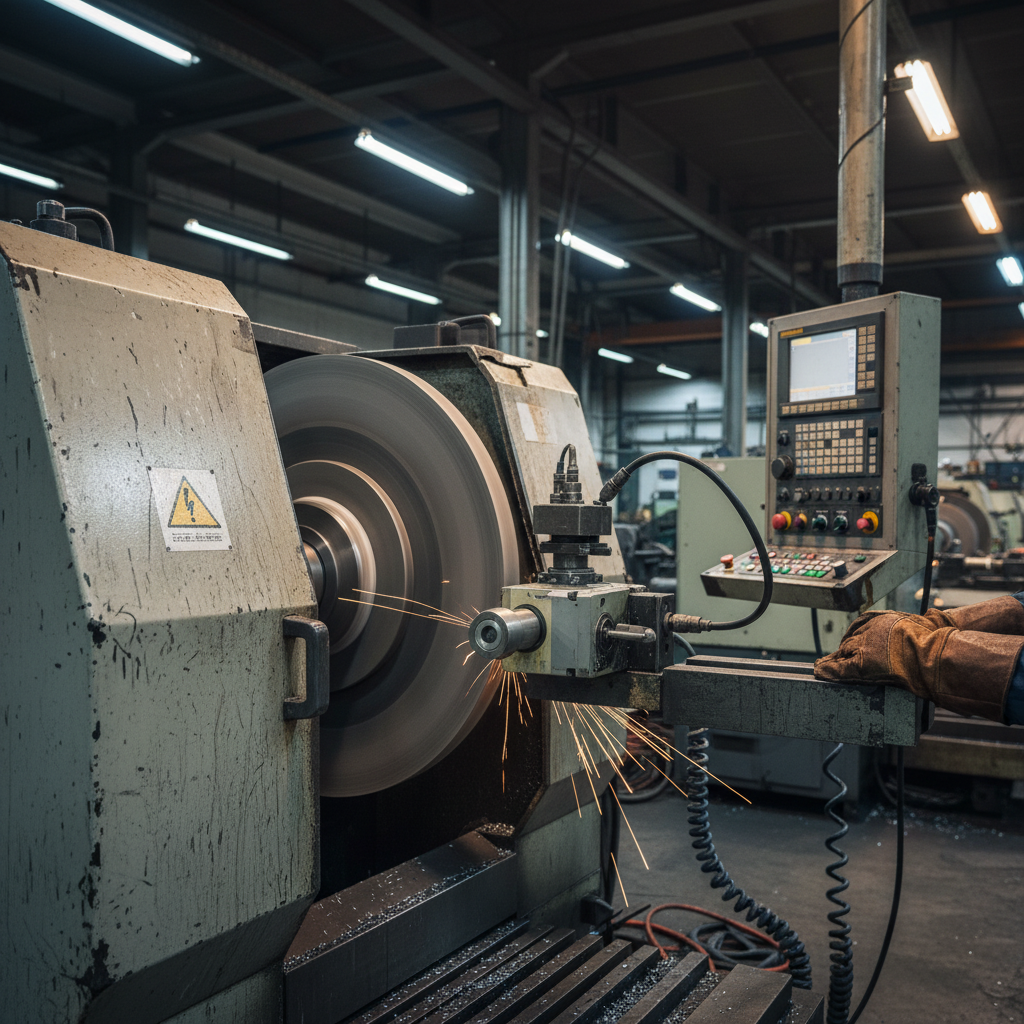
In high-precision aerospace and gas turbine manufacturing, grinding nickel-based superalloys like Inconel 718 and Hastelloy presents an extreme metallurgical challenge. These materials are engineered to maintain exceptional mechanical strength at elevated temperatures, but their low thermal conductivity (approximately 11 W/m·K) and high ductility make them highly susceptible to work hardening and grinding burn.
When grinding heat-resistant superalloys (HRSA), over 80% of the generated grinding energy is converted into thermal energy. Without precise process control, this heat accumulates rapidly in the grinding zone, leading to phase transformations, tensile residual stresses, and micro-cracking. To achieve a defect-free surface finish, technical engineers must optimize three critical, interacting pillars of the grinding system: the wheel’s macro-structure, its dynamic balance state, and the kinematics of the dressing process.
This technical guide analyzes how combining muelas abrasivas de estructura abierta with a rigorous G2.5 balance grade and optimized dressing speed ratios ($q_d$) systematically eliminates grinding burn during Inconel 718 grinding operations.
The Metallurgical Challenge of Inconel 718 Grinding
Inconel 718 is a precipitation-hardened nickel-chromium alloy containing significant amounts of niobium, molybdenum, and titanium. Its high shear strength and tendency to work-harden rapidly mean that the abrasive grains must exert massive mechanical force to initiate chip formation.
During conventional grinding, ductile chips easily adhere to the grinding wheel’s surface—a phenomenon known as wheel loading. Once loading occurs, the wheel loses its cutting ability, and the grinding mechanism shifts from clean cutting to severe plowing and friction. This friction spikes the temperature in the grinding zone beyond the alloy’s critical recrystallization threshold (typically exceeding 650°C to 800°C), resulting in visible oxidation (burn colors), metallurgical damage, and a dramatic drop in fatigue life. For a deeper understanding of these metallurgical hazards, see our guide on Cómo evitar el endurecimiento por deformación en Hastelloy e Inconel: por qué las muelas abrasivas de estructura abierta son fundamentales..
The Role of Open-Structure Grinding Wheels in Thermal Management
Open-structure grinding wheels (often designated with structure numbers from 12 to 18 or manufactured using specialized induced-pore technology) are engineered with highly interconnected, large macro-pores. Unlike standard dense wheels, open-structure vitrified wheels offer three distinct thermodynamic and mechanical advantages:
- Chip Clearance Pockets: The massive pore space acts as micro-reservoirs that temporarily store long, ductile nickel chips during the grinding arc, preventing them from fusing to the abrasive grains and causing wheel loading.
- Enhanced Coolant Transport: The interconnected pore network acts as internal conduits, carrying high-pressure coolant directly into the center of the grinding zone. This breaks through the high-velocity air barrier surrounding the spinning wheel, preventing coolant starvation.
- Reduced Specific Grinding Energy: By utilizing micro-fracturing ceramic grains (such as seeded gel or sol-gel alumina) in a highly porous vitrified matrix, the wheel maintains a continuous self-sharpening action under lower normal forces.
While open-structure wheels are highly effective, their thermal behavior differs significantly from other materials. For instance, while technical ceramics require open structures to prevent brittle edge-chipping, nickel alloys require them to manage extreme ductility and thermal load. You can compare these mechanisms in our specialized article on Selecting Open-Structure Grinding Wheels for Technical Ceramic Grinding.
G2.5 Balance: Eliminating Micro-Vibration and Thermal Spikes
Even the most advanced open-structure wheel will cause grinding burn if the system suffers from dynamic instability. In high-speed grinding (33 m/s to 50 m/s and above), dynamic unbalance generates harmonic vibrations that directly affect the surface integrity of the workpiece.
Why Dynamic Unbalance Causes Grinding Burn
When a grinding wheel is unbalanced, it undergoes a centrifugal force that rotates at the spindle frequency. This force causes cyclic variations in the actual depth of cut ($a_e$) during each spindle rotation.
As the wheel vibrates, the peak-to-valley variation in normal forces causes localized “micro-rubbing” zones. At the peak of the vibration wave, the wheel is forced deeper into the material, causing a momentary spike in normal force and frictional heat. At the valley of the wave, the wheel loses optimal contact, leading to plowing rather than clean cutting. These high-frequency thermal spikes rapidly exceed the thermal damage threshold of Inconel 718, causing periodic, striped grinding burns (chatter-induced burns) across the component surface.
Implementing the ISO 1940 G2.5 Balance Standard
To prevent these localized thermal spikes, grinding wheels must be dynamically balanced to the ISO 1940 G2.5 balance grade (or tighter). The G-value represents the maximum permissible vibration velocity in millimeters per second (mm/s) at the operating speed. For G2.5, the residual unbalance limit ($U_{per}$) is calculated using the formula:
$$U_{per} = 1000 \times \frac{G \times m}{\omega}$$
Dónde:
• $G = 2.5 \text{ mm/s}$
• $m = \text{mass of the grinding wheel assembly (kg)}$
• $\omega = \text{angular frequency of the wheel at operating speed (rad/s)}$
Achieving G2.5 balance requires a multi-stage balancing protocol:
- Static Balancing: Performed on parallel knife-edge ways to correct gross gravitational asymmetry.
- Dynamic Dual-Plane Balancing: Conducted on the machine spindle using automatic liquid-balancing systems or manual balance-weight rings. This eliminates both static unbalance and couple unbalance (which causes wobbling along the spindle axis).
- In-Situ Re-balancing: Because open-structure wheels absorb coolant like a sponge, they must be spun dry before balancing, and re-balanced after initial coolant saturation to compensate for uneven fluid retention.
Dressing Speed Ratio ($q_d$): Designing the Active Wheel Topography
Dressing is not merely a method to restore the wheel’s geometric profile; it is the process that designs the wheel’s micro-topography. The sharpness, density, and distribution of active cutting edges are directly governed by the kinematics of the rotary diamond dresser.
For high-performance creep-feed and profile grinding of Inconel 718, rotary disk dressers are preferred. The most critical kinematic parameter in rotary dressing is the dressing speed ratio ($q_d$), defined as the ratio between the peripheral speed of the rotary dresser ($v_d$) and the peripheral speed of the grinding wheel ($v_s$):
$$q_d = \frac{v_d}{v_s}$$
Kinematic Modes: Co-Directional vs. Counter-Directional Dressing
The sign of $q_d$ is determined by the relative direction of the contact surfaces at the dressing zone:
- Counter-Directional Dressing ($q_d < 0$): The dresser and the grinding wheel move in opposite directions at the contact point. This induces high relative impact forces, fracturing the abrasive grains cleanly and generating a highly open, aggressive, and sharp wheel topography.
- Co-Directional Dressing ($q_d > 0$): The dresser and the wheel move in the same direction at the contact point. This reduces the relative velocity ($v_{cd} = v_s – v_d$) at the interface, resulting in lower impact forces and a dominant crushing or rubbing action. This tends to flatten the abrasive grains, increasing the active grit density and producing a smoother workpiece surface finish, though at the risk of higher grinding temperatures and potential thermal damage if not strictly controlled.
Optimizing $q_d$ for Open-Structure Wheels
For highly porous, open-structure vitrified CBN or aluminum oxide wheels, selecting the precise dressing speed ratio is paramount to maintaining the wheel’s self-sharpening characteristics. The recommended operating windows are defined as follows:
- Roughing Operations ($q_d = -0.5$ to $-0.8$): Counter-directional dressing in this range ensures maximum chip clearance and high material removal rates (MRR) without thermal accumulation.
- Finishing Operations ($q_d = +0.4$ to $+0.7$): Co-directional dressing within these parameters generates a controlled plateau on the active grain tips, balancing surface finish requirements ($R_a$) with a safe thermal threshold to prevent surface temper or tensile residual stresses.
The Critical Role of ISO G2.5 Dynamic Balancing
Even with an optimized dressing ratio, mechanical vibration can completely undermine the integrity of the grinding process. Dynamic unbalance generates a rotating centrifugal force that increases quadratically with wheel speed ($v_s$). Under ISO 1940-1, a G2.5 balance grade is the industrial standard for high-performance grinding spindles, ensuring a maximum permissible residual unbalance that prevents harmonic excitation.
If a spindle operates outside the G2.5 limit, the resulting runout causes a cyclic variation in the actual depth of cut ($a_e$) and the dressing depth ($a_d$). This introduces two critical failure modes:
- Dressing Waveform Transfer: The dresser periodically cuts deeper and shallower into the wheel, creating a wavy topography. The “high spots” on the wheel experience excessive load and friction, leading to localized, periodic grinding burn (chatter-induced burn).
- Accelerated Grain Fracture: Unbalanced vibrations cause premature, uncontrolled micro-fracturing of the open-structure bond, leading to rapid wheel wear and loss of profile geometry.
Troubleshooting Grinding Burn and Wheel Instability
| Observed Symptom | Root Cause Analysis | Corrective Action |
|---|---|---|
| Periodic, striped burn marks on workpiece | Spindle unbalance exceeding G2.5; wheel runout transferring to dressing path. | Re-balance the wheel assembly to G2.5 or better; inspect spindle bearings for axial play. |
| Rapid wheel glazing and immediate thermal burn | Dressing ratio $q_d$ too close to $+1.0$ (synchronous speed), causing grain burnishing. | Adjust dresser speed to target a $q_d$ of $+0.5$ to $+0.7$, or switch to counter-directional dressing ($q_d < 0$). |
| Inconsistent surface finish withintermittent burn patches | Variable porosity collapse due to non-uniform dressing lead or spindle speed fluctuations. | Verify dresser traverse rate stability; ensure the dressing speed ratio ($q_d$) is kept constant across the entire wheel face. |
| High-frequency chatter and thermal cracking | Excitation of spindle natural frequencies from poor wheel balancing ($> G6.3$) combined with aggressive dressing. | Re-balance the wheel assembly to G2.5 or better; reduce dressing depth of cut ($a_d$) and optimize dressing lead ($s_d$). |
Implementing G2.5 Dynamic Balancing Protocols
For high-productivity grinding operations, achieving an ISO 1940-1 G2.5 balance grade is a critical prerequisite to preventing grinding burn. Open-structure wheels, by their very nature, possess a highly porous matrix which inherently leads to localized volumetric density variations. Because the distribution of abrasive grains, vitrified bond, and induced air pores is never perfectly homogenous throughout the wheel’s volume, a physical mass imbalance is inevitable. When rotated at high operating speeds, this minor structural non-uniformity translates directly into dynamic unbalance.
The Impact of Unbalance: Cyclic Depth-of-Cut Variations
In high-precision grinding, evena micro-scale displacement of the wheel’s center of mass relative to its rotational axis induces significant centrifugal forces. These forces scale quadratically with the rotational speed, meaning that at modern high-speed grinding velocities, even a tiny physical eccentricity generates a substantial, rotating dynamic force vector.
This dynamic force vector acts directly upon the machine tool spindle, causing periodic deflection of the entire wheel-spindle assembly. As the wheel rotates, this deflection manifests as a cyclic variation in the actual depth of cut (ae). Instead of maintaining a constant, uniform engagement with the workpiece, the wheel continuously moves closer to and further from the surface at a frequency corresponding to the rotational speed (1X vibration). At the peak of this oscillation, the instantaneous material removal rate increases dramatically
, driving the localized temperature past the critical phase-transformation threshold of the workpiece material. This sudden surge in thermal energy cannot be dissipated quickly enough by the coolant, especially when the open-pore channels are momentarily compressed or bypassed due to the vibration. The resulting localized thermal spikes lead to periodic, striped “chatter burn” marks across the ground surface, characterized by alternating bands of tensile residual stress and untempered martensite.
The Mechanics of Chatter Burn and Thermal Damage
Unlike continuous grinding burn, which is typically caused by a dull wheel, insufficient coolant flow, or an incorrect dressing speed ratio (qd), chatter burn is highly localized and cyclic. The periodic deflection of the wheel-spindle assembly creates alternating zones of high and low contact pressure. During the high-pressure phase of the cycle, the extreme frictional forces overcome the shear strength of the binder, but instead of inducing clean self-sharpening, the rapid energy input exceeds the thermal dissipation capacity of the open-pore structure.
This localized thermal spike rapidly heats the surface layer of the steel past its austenitizing temperature. As the wheel moves past this zone, the massive thermal mass of the underlying bulk material acts as a heat sink, rapidly quenching the heated zone. This rapid cooling transforms the surface layer into brittle, untempered martensite (white layer), which is highly susceptible to micro-cracking and premature component failure under fatigue loading. Between these peaks, the lower contact pressure leaves unburned bands, resulting in the characteristic striped visual pattern of chatter burn.
Achieving G2.5 Dynamic Balance for Open-Structure Wheels
To eliminate these cyclic thermal spikes, the grinding wheel must be balanced to a highly stringent standard. For high-precision grinding operations utilizing open-structure wheels, balancing to the ISO 1940-1 G2.5 vibration grade is the industry benchmark. Because open-structure wheels feature high porosity and an inherently less homogeneous density distribution than dense-structure wheels, static balancing alone is insufficient. Dynamic balancing—which compensates for both static unbalance and couple unbalance—is mandatory.

Achieving a G2.5 dynamic balance grade can be accomplished using two primary methodologies:
- Manual Balancing Flanges: This method utilizes specialized wheel flanges equipped with circular dovetail slots or tracks containing movable balance weights (often called balance dogs). Using a portable vibration analyzer, the operator measures the amplitude and phase of the 1X vibration at the operating speed. The weights are then shifted to precise angular positions calculated by the analyzer to counteract the heavy spot of the wheel-flange assembly.
- Automatic In-Spindle Balancing Systems: For high-productivity CNC grinding machines, automatic dynamic balancing systems are integrated directly into the spindle assembly. These systems utilize electro-mechanical or liquid-injection (hydro-balancing) mechanisms. They continuously monitor vibration levels during operation and automatically adjust internal counterweights or inject precise amounts of fluid into balancing chambers to maintain G2.5 or better balancing grades in real-time, compensating for wheel wear and coolant absorption.
The balancing protocol must always follow a strict sequence: first, rough-dress the wheel to ensure concentricity; second, perform a dynamic pre-balancing; third, execute the final precision dressing cycle using the optimal dressing speed ratio (typically qd = +0.6 to +0.8 for open-structure wheels); and finally, conduct the fine dynamic balancing at the actual operational grinding speed.
Conclusion: Synergizing Dressing Ratios and Wheel Balance
Preventing grinding burn on sensitive, high-value components requires a holistic approach that addresses both the micro-geometry of the wheel surface and the macro-dynamics of the grinding system. Open-structure vitrified wheels offer the ideal physical architecture for cool grinding, but their advantages can only be fully realized when paired with precise dressing and balancing strategies.
By strictly controlling the dressing speed ratio (qd) to avoid both wheel glazing and premature grit pull-out, and by dynamically balancing the wheel assembly to the G2.5 standard, manufacturers can completely eliminate both uniform thermal burn and cyclic chatter burn. This dual-optimization strategy ensures maximum material removal rates, superior surface integrity, and extended tool life in the most demanding B2B precision grinding applications.
Optimize Your Precision Grinding Operations
En Muela abrasiva Co., Ltd. de Zhengzhou Zhongxin., we specialize in manufacturing high-performance open-structure grinding wheels engineered to prevent thermal damage in high-precision industrial applications. Our technical engineering team is ready to assist you in optimizing your dressing speed ratios and achieving G2.5 dynamic balancing for your specific spindle configurations.
Contact our application specialists today to discuss your technical requirements and request a customized quotation:
Muela abrasiva Co., Ltd. de Zhengzhou Zhongxin.
Correo electrónico: root@shalun.net
Teléfono/WhatsApp: +86 15538050608
Telephone: 0371-62513386
DIRECCIÓN: No. 1111-1, Avenida Kexue, Distrito Shangjie, Zhengzhou, Henan, China.