
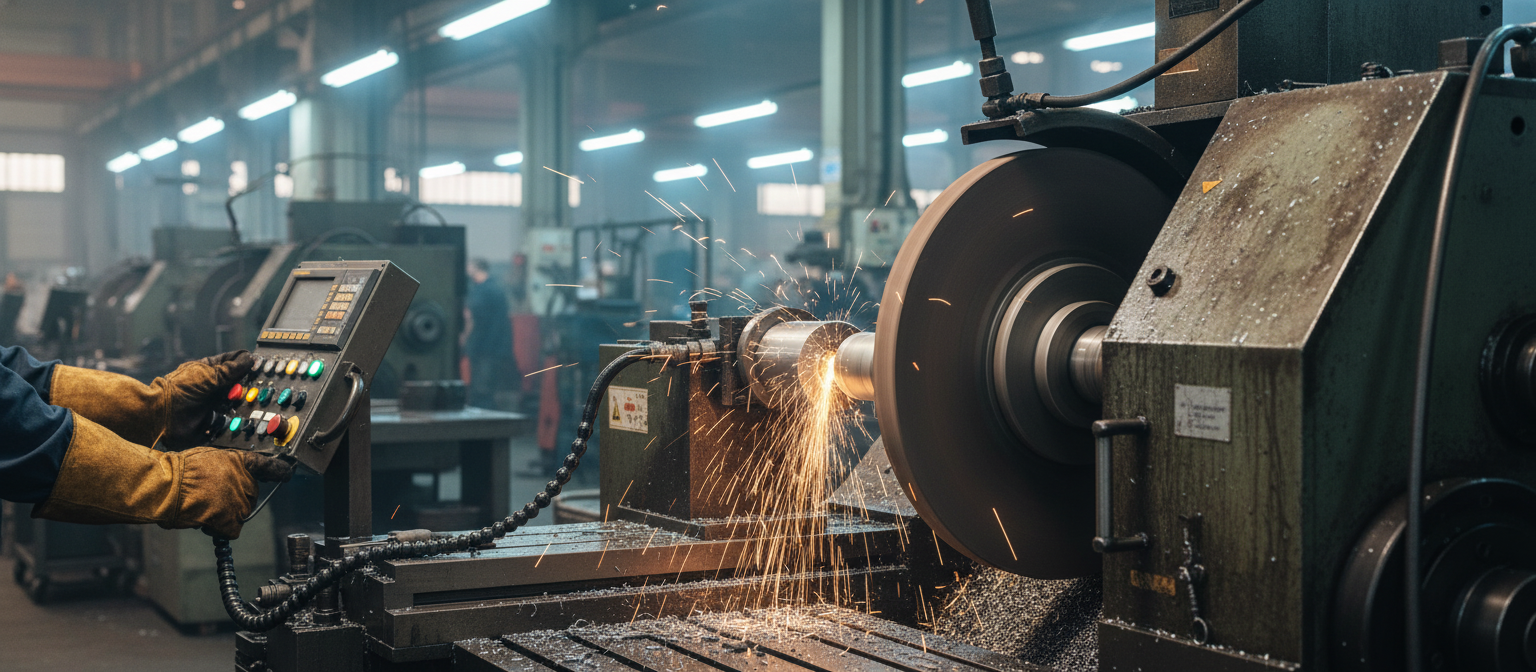
Controlling Normal Forces in PCBN Grinding: The Open-Structure Wheel Advantage

Controlling Normal Forces in PCBN Grinding: The Open-Structure Wheel Advantage

In the high-precision world of superhard tool manufacturing, Polycrystalline Cubic Boron Nitride (PCBN) stands as the material of choice for machining hardened steels, cast irons, and high-temperature superalloys. However, the very properties that make PCBN an exceptional cutting tool material—its extreme hardness, high wear resistance, and high thermal stability—render it notoriously difficult to machine during the tool manufacturing and re-grinding processes.

For precision grinding engineers, the primary bottleneck in PCBN insert manufacturing is the generation of excessive normal grinding force ($F_n$). High normal forces lead to severe mechanical deflection, accelerated wheel wear, thermal damage, and, most critically, micro-chipping along the cutting edge. To combat these challenges, advanced tool manufacturers are transitioning from conventional dense superabrasive wheels to engineered vitrified bond open-structure grinding wheels. This technical article explores the tribological and mechanical advantages of open-structure wheels in controlling normal forces, ensuring edge chipping prevention, and optimizing surface finish ($R_a$) during PCBN grinding operations.


The Physics of PCBN Grinding: Why Normal Forces Dominate

During any grinding process, the total grinding force is resolved into three orthogonal components: tangential force ($F_t$), normal force ($F_n$), and axial force ($F_a$). In cylindrical or surface grinding of ductile metals, the tangential force (which correlates directly with spindle power consumption) is highly significant. However, in the grinding of superhard materials like PCBN, the normal grinding force ($F_n$) is highly dominant, often reaching a force ratio ($F_n / F_t$) of 4:1 to 8:1.

This disproportionately high normal force is a direct consequence of the physical interaction between the diamond abrasive grains and the PCBN workpiece. PCBN composites consist of ultra-hard cubic boron nitride grains bound together by a ceramic (e.g., $TiN$, $TiC$, $Al_2O_3$) or metallic (Cobalt) binder matrix. To remove material, the diamond grains on the grinding wheel must penetrate this highly resistant composite. The extreme resistance to penetration generates massive elastic deformation and high normal contact pressure in the grinding zone.

When the specific normal grinding force ($F’_n$) exceeds the structural threshold of the PCBN edge, several detrimental phenomena occur:

  • Micro-Chipping and Edge Crumbling: PCBN is inherently brittle. High normal forces cause stress concentration at the unsupported boundary of the insert, leading to micro-fractures and edge chipping. Preventing this is a primary quality control objective in PCBN insert manufacturing.
  • Sub-Surface Damage: Residual tensile stresses are induced deep into the PCBN substrate, reducing the tool’s fatigue life and leading to premature failure during heavy-duty interrupted cutting operations.
  • Wheel Glazing and Loading: High normal pressures crush the abrasive grains prematurely or force the binder phase of the PCBN to load into the wheel pores, compounding the grinding force in a destructive feedback loop.

To mitigate these forces, engineers must optimize the grinding wheel’s topology. This is where the open-structure design becomes critical. For a broader understanding of how these principles apply to other brittle materials, engineers can refer to our guide on selecting open-structure grinding wheels for technical ceramic grinding.


The Anatomy of an Open-Structure Grinding Wheel

An open-structure grinding wheel is engineered with a highly porous, interconnected matrix. Unlike standard, dense superabrasive wheels where the abrasive grains, bond material, and natural pores are tightly packed, open-structure wheels utilize specialized pore-inducing agents (such as temporary organic fillers or hollow ceramic spheres) during the manufacturing process to create precise, controlled macro-porosity.

In a high-performance vitrified bond diamond wheel designed for PCBN grinding, the volumetric composition typically consists of:

  • Diamond Abrasive (35% – 45%): High-strength, thermally stable monocrystalline or micro-crystalline diamond grains.
  • Vitrified Bond (15% – 25%): A rigid glass-ceramic matrix that provides high holding power for the diamond grains and excellent thermal resistance.
  • Induced Porosity (35% – 50%): Interconnected, open-pore channels that run throughout the active abrasive layer.

This high volume of open pores transforms the wheel from a solid grinding face into a highly efficient fluid-transport and chip-evacuation system. The open pores act as built-in reservoirs that carry coolant directly into the arc of cut and provide immediate storage pockets for the microscopic PCBN chips before they are slung out by centrifugal force.


Mechanics of Force Reduction: How Porosity Lowers $F’_n$

How exactly does an open structure reduce the normal grinding force? The mechanical and thermal dynamics can be broken down into three key areas:

1. Minimizing Contact Area and Friction

The normal grinding force is heavily dependent on the real area of contact between the grinding wheel and the workpiece. In a dense wheel, the bond material and closely packed grains slide against the PCBN surface, creating significant frictional drag. An open-structure wheel reduces the active contact area. Because the bond is confined to narrow “bridges” surrounding the large pores, sliding friction is minimized. The energy spent on useless rubbing is redirected into efficient micro-cutting, which dramatically lowers the specific grinding energy and the associated normal force. To dive deeper into the relationship between friction, force ratios, and energy, read our technical analysis on optimizing specific grinding energy and force ratios with open-structure wheels.

2. Eliminating Wheel Glazing and Loading

During PCBN grinding, the metallic or ceramic binders of the PCBN insert can melt or plastically deform under high temperatures, adhering to the wheel face—a phenomenon known as wheel loading. Additionally, if the bond of the wheel is too hard or lacks porosity, the diamond grains will flatten rather than fracture or release, leading to wheel glazing. Both glazing and loading drastically increase the contact area between the wheel and the PCBN workpiece, causing normal forces to spike exponentially.

Open-structure vitrified diamond wheels address this issue by introducing controlled, interconnected porosity. The pore spaces act as micro-reservoirs for coolant, delivering it directly to the grinding zone to suppress thermal deformation of the PCBN binder. Furthermore, these pores provide dedicated chip pockets that temporarily collect grinding debris (swarf) before flushing it out, preventing the loading of metal or ceramic phase materials onto the wheel face.

3. Structural Mechanics of Normal Force Reduction

In precision PCBN grinding, the normal force (Fn) is typically 3 to 5 times higher than the tangential force (Ft). This high force ratio is a consequence of PCBN’s extreme hardness (typically 3000–4500 HV) and resistance to plastic deformation. When normal forces exceed critical thresholds, they induce micro-cracking, subsurface damage, and rapid edge chipping on the PCBN insert.

By utilizing an open-structure wheel, the active grit density on the wheel face is optimized. Instead of a continuous, dense barrier of diamond and bond, the open pore structure reduces the instantaneous contact area. This yields several mechanical advantages:

  • Higher Specific Grinding Energy Efficiency: Each individual diamond grain penetrates the PCBN material more deeply and cleanly, transitioning from plowing to efficient micro-cutting at lower threshold forces.
  • Self-Sharpening Mechanics: The vitrified bond bridges in an open-structure wheel are engineered to fracture under controlled loads. As a grain dulls and the localized normal force rises, the surrounding bond post releases the worn grain, exposing a sharp, new cutting edge without requiring frequent dressing.
  • Deflection Mitigation: Lower normal forces minimize elastic deflection of both the grinding spindle and the workpiece clamping fixture, ensuring sub-micron dimensional accuracy and strict geometric tolerances.

4. Troubleshooting Normal Force Spikes in PCBN Grinding

Maintaining stable normal forces requires balancing wheel specifications with kinematic grinding parameters. The table below outlines common failure modes associated with elevated grinding forces and how to resolve them using open-structure wheel technology.

Observed IssueRoot Cause (Force-Related)Corrective Action / Open-Structure Advantage
Edge chipping on PCBN insertExcessive normal force causing mechanical shock at the entry/exit points.Transition to an open-structure wheel with a softer bond grade to lower threshold penetration forces.
Thermal cracking (cobweb cracks)Inadequate coolant delivery to the grinding zone, leading to localized thermal spikes.Utilize highly porous vitrified wheels to transport coolant directly into the arc of cut via the pore network.
Rapid wheel wear / loss of profileBond is too weak for the high force levels, causing premature grain release.Optimize the volumetric ratio of diamond, bond, and pore space; ensure the bond chemistry is tailored for PCBN.
Surface finish deterioration (burn marks)Wheel loading and glazing shifting the grinding mechanism from cutting to rubbing.Increase dressing frequency or switch to an open-structure wheel with integrated self-sharpening properties.

5. Recommended Process Parameters

To fully leverage the open-structure wheel advantage, grinding parameters must be tuned to match the high-porosity characteristics. For vitrified diamond wheels grinding PCBN, the following baseline parameters are recommended:

  • Wheel Speed (vs): 80 to 120 m/s. Higher speeds reduce the chip thickness per grit, lowering forces, but require highly balanced spindles.
  • Feed Rate (vf): 0.5 to 2.0 mm/min (plunge grinding) or tailored to the specific machine rigidity.
  • Coolant Pressure: Match the nozzle outlet velocity to the peripheral wheel speed to break the boundary air layer and fully saturate the open pores.

Conclusion

Controlling normal forces is the single most critical factor in achieving high-yield, defect-free PCBN grinding. Standard dense-bond wheels struggle with thermal management, loading, and high force ratios, leading to compromised tool integrity and frequent downtime. Open-structure vitrified diamond wheels solve these challenges at a fundamental level by optimizing chip clearance, enhancing coolant delivery, and promoting controlled self-sharpening. By transitioning to open-structure wheel designs, manufacturers can achieve superior surface finishes, longer wheel life, and significantly reduced cycle times in their PCBN tool production.
Tags
Share

Partner with the PCBN Grinding Experts

Are you looking to eliminate edge chipping, reduce cycle times, and optimize your PCBN grinding processes? Zhengzhou Zhongxin Grinding Wheel Co., Ltd. specializes in engineering high-performance, open-structure vitrified diamond wheels tailored to your specific application requirements.

Contact our technical engineering

Controlling Normal Forces in PCBN Grinding: The Open-Structure Wheel Advantage

In the high-precision world of superhard tool manufacturing, Polycrystalline Cubic Boron Nitride (PCBN) stands as the gold standard for machining hardened steels, cast irons, and superalloys. However, the very properties that make PCBN highly desirable—its extreme hardness, wear resistance, and thermal stability—also make it incredibly difficult to machine during the tool fabrication and re-sharpening stages. In PCBN insert manufacturing, particularly during peripheral plunge-face grinding, manufacturers face a persistent and costly challenge: micro-chipping along the cutting edge.

Edge chipping is primarily driven by excessive normal grinding forces (F’n). When the normal force surpasses the mechanical threshold of the PCBN composite, micro-fractures propagate through the binder phase, ruining the tool’s cutting edge geometry and surface finish (Ra). To combat this, precision grinding engineers are increasingly turning to open-structure grinding wheels. By utilizing engineered porosity, these advanced vitrified diamond wheels optimize the force ratio, dramatically reduce thermal load, and provide a reliable pathway to edge chipping prevention.


The Physics of PCBN Grinding: Why Normal Force (F’n) Rules the Process

Grinding is fundamentally a multi-grit micro-cutting process. The total grinding force exerted between the grinding wheel and the PCBN insert can be resolved into two primary components:

  • Tangential Grinding Force (F’t): The force acting tangent to the wheel rotation, directly related to power consumption and material removal rate (MRR).
  • Normal Grinding Force (F’n): The force acting perpendicular to the contact zone, pushing the wheel directly into the workpiece.

In conventional grinding of ductile materials, the ratio of normal-to-tangential force (F’n / F’t) typically ranges from 1.5 to 3.0. However, in PCBN grinding, because of the material’s extreme resistance to penetration, this force ratio can spike to 4.0 or even 6.0. This means that for every Newton of force removing material, up to six Newtons of force are pushing directly against the delicate, unsupported edge of the PCBN insert.

When F’n becomes too high, several detrimental phenomena occur:

  1. Micro-Chipping: The high localized compressive stress at the grinding zone exceeds the fracture toughness of the PCBN matrix, leading to micro-cracking and macro-chipping at the exit edge.
  2. Sub-Surface Damage: High normal forces induce residual tensile stresses and micro-cracking beneath the ground surface, compromising the insert’s tool life during subsequent metal cutting operations.
  3. Wheel Deflection and Geometric Inaccuracy: High forces cause elastic deformation of the grinding spindle and the wheel itself, resulting in taper errors and dimensional deviation.

To understand how to control these forces, we must look at the contact mechanics of the grinding wheel. For more on how force ratios affect overall process efficiency, see our detailed guide on Optimizing Specific Grinding Energy: Using Open-Structure Wheels to Balance Force Ratios.


The Anatomy of an Open-Structure Grinding Wheel

An open-structure grinding wheel is engineered with highly controlled, interconnected porosity. Traditional superabrasive wheels feature a dense structure where diamond grains are tightly packed within a metal, resin, or vitrified bond. While robust, these dense wheels lack the chip clearance and coolant transport capabilities required for grinding ultra-hard materials like PCBN.

In contrast, an open-structure wheel utilizes specialized pore-inducing agents during the manufacturing process to create a highly porous vitrified matrix. The volume of pores can exceed 50% of the total wheel volume. This structure provides three critical physical features:

  1. Chip Clearance Pockets: The open pores act as temporary storage reservoirs for the microscopic PCBN chips and binder debris generated during grinding, preventing them from loading or clogging the wheel face.
  2. Coolant Channels: The interconnected pores act as micro-conduits, allowing grinding fluid to be drawn directly into the grinding arc by capillary action and centrifugal force.
  3. Reduced Contact Area: The porous structure reduces the actual contact area between the bond and the workpiece, concentrating the grinding pressure solely on the active diamond abrasive grains.

For high-hardness applications, selecting the right porosity and bond system is critical. To explore how these structures are engineered, refer to our comprehensive article on Selecting Open-Structure Grinding Wheels for Technical Ceramic Grinding.


How Open-Structure Wheels Lower Normal Grinding Forces

The reduction of normal grinding force (F’n) when using open-structure wheels is not accidental; it is a direct consequence of grinding tribology and thermodynamics. Let’s break down the physical mechanisms:

1. Elimination of Wheel Loading and Glazing

During PCBN grinding, the metallic binder phase (such as cobalt or ceramic titanium nitride/carbide) can become highly ductile under localized friction heat. In a standard dense wheel, these metallic particles adhere to the bond and the diamond grains, a phenomenon known as “wheel loading.” Once loaded, the wheel loses its cutting ability. The loaded metal rubs against the PCBN insert, causing the normal force to skyrocket as the operator or machine CNC tries to maintain the programmed feed rate.

The open-structure wheel prevents loading by providing ample space for these ductile chips. Because the chips are easily carried away by the coolant, the diamond grits remain clean and sharp, maintaining a constant, low normal force throughout the grinding cycle.

2. Enhanced Coolant Penetration and Thermal Mitigation

Grinding PCBN generates immense frictional heat. If the temperature in the grinding zone exceeds the thermal stability limit of the diamond wheel or the PCBN binder, thermal expansion occurs. This localized thermal expansion increases the actual depth of cut, leading to a sudden spike in normal forces and subsequent thermal cracking.

Standard grinding wheels generate a high-velocity boundary layer of air that acts as an aerodynamic barrier, deflecting coolant away from the contact zone. Open-structure wheels break this barrier. The porous surface absorbs the coolant and carries it directly into the grinding interface, providing superior lubrication and cooling. This maintains thermal equilibrium, prevents thermal expansion, and keeps normal forces stable.

3. Controlled Self-Sharpening and Optimal Micro-Fracturing

An open-structure vitrified bond is engineered to have a precise, controlled level of mechanical strength. As the active diamond grains dull, the normal force acting on those individual grains increases. In an open-structure wheel, because the bond bridges are thin and well-defined, this localized increase in force causes the bond to micro-fracture, releasing the dull diamond grit and exposing fresh, sharp diamond edges underneath.

This continuous self-sharpening mechanism ensures that the wheel never “glazes.” In dense wheels, dull grains are retained too long, leading to a massive buildup of normal force before the grain finally pulls out. The self-sharpening action of open-structure wheels caps the maximum normal force, keeping it well below the threshold that causes edge chipping.


Technical Comparison: Standard vs. Open-Structure Vitrified Diamond Wheels

The table below highlights the performance differences observed during the plunge-face grinding of PCBN inserts (65% CBN content, ceramic binder) using standard vitrified diamond wheels versus Zhengzhou Zhongxin’s engineered open-structure vitrified diamond wheels.

Performance MetricStandard Vitrified Diamond WheelOpen-Structure Vitrified Diamond Wheel
Porosity Volume (%)10% – 15%45% – 55%
Specific Normal Force (F’n)120 – 150 N/mm60 – 80 N/mm (Up to 50% Reduction)
Edge Chipping Rate (%)< 8.5% (with strict feed limits)< 0.5% (at higher material removal rates)
Surface Roughness (Ra)0.45 µm (highly variable due to glazing)0.22 µm (consistent and repeatable)
G-Ratio (Volumetric Material Removal / Volumetric Wheel Wear)80 – 120250 – 320 (Significantly extended dressing intervals)

This dramatic shift in performance highlights how controlling normal forces directly correlates with tool quality. In PCBN grinding, high normal forces (Fn) deform the grinding machine spindle and the tool fixture, leading to dimensional inaccuracies and micro-chipping along the cutting edge. Zhengzhou Zhongxin’s engineered open-structure design addresses this root cause by fundamentally altering the chip-formation mechanics.

The Tribological Mechanism: Chip Clearance and Coolant Delivery

In conventional, dense vitrified diamond wheels, the lack of chip clearance space causes the microscopic chips of PCBN and ceramic binder to become trapped between the diamond grains. This phenomenon, known as wheel loading or glazing, leads to friction-dominated contact rather than clean cutting. As a result, normal forces spike exponentially.

With an open-structure wheel boasting 45% to 55% porosity, the pores act as highly efficient chip pockets. These pockets temporarily store the removed PCBN particles until they are flushed out by the centrifugal force of the wheel rotation. Furthermore, these interconnected pores serve as micro-conduits for grinding fluid, transporting coolant directly into the high-pressure contact zone. This dramatically reduces thermal friction, prevents phase transformation in the PCBN material, and maintains a sharp, free-cutting action.

Optimizing Parameters for Open-Structure PCBN Grinding

To maximize the advantages of open-structure vitrified diamond wheels, operators must calibrate their grinding parameters to match the high porosity characteristics. Below is a practical troubleshooting and optimization matrix for PCBN tool manufacturing:

Challenge / IssueRoot CauseRecommended Adjustment
Rapid Wheel WearDressing interval too frequent or feed rate too aggressive for the bond strength.Reduce dressing depth of cut (e.g., to 2-5 µm per pass); optimize the speed ratio (q-factor) during dressing to 0.6 – 0.8.
Minor Edge FlakingLocalized thermal shock or excessive mechanical impact.Increase coolant pressure to flush the pores; verify wheel speed (Vs is optimal at 25 – 35 m/s for high-porosity wheels).
Surface Finish DegradationDiamond grit dulling or uneven dressing.Implement a mild dressing cycle with a rotary diamond dresser; ensure the open-structure wheel is dynamically balanced.
Inconsistent Part GeometryMachine deflection caused by residual normal forces.Reduce the spark-out time slightly, as the free-cutting nature of the open structure requires less dwell time to relieve force.

Conclusion: A New Paradigm in PCBN Processing

Controlling normal forces is the single most critical factor in achieving high-yield, defect-free grinding of PCBN cutting inserts. Conventional vitrified diamond wheels, constrained by low porosity, inevitably lead to high normal forces, thermal damage, and costly edge chipping. By contrast, Zhengzhou Zhongxin’s engineered open-structure vitrified diamond wheels offer a highly porous, free-cutting matrix that halves normal forces, slashes edge chipping rates to near zero, and dramatically extends wheel life.

For industrial tool manufacturers, transitioning to open-structure technology is not merely an incremental improvement—it is a strategic shift that unlocks higher throughput, superior surface finishes, and reduced total manufacturing costs per insert.

Partner with the PCBN Grinding Experts

Are you looking to eliminate edge chipping, reduce cycle times, and optimize your PCBN grinding processes? Zhengzhou Zhongxin Grinding Wheel Co., Ltd. specializes in engineering high-performance, open-structure vitrified diamond wheels tailored to your specific application requirements.

Contact our technical engineering

Tags
Share