

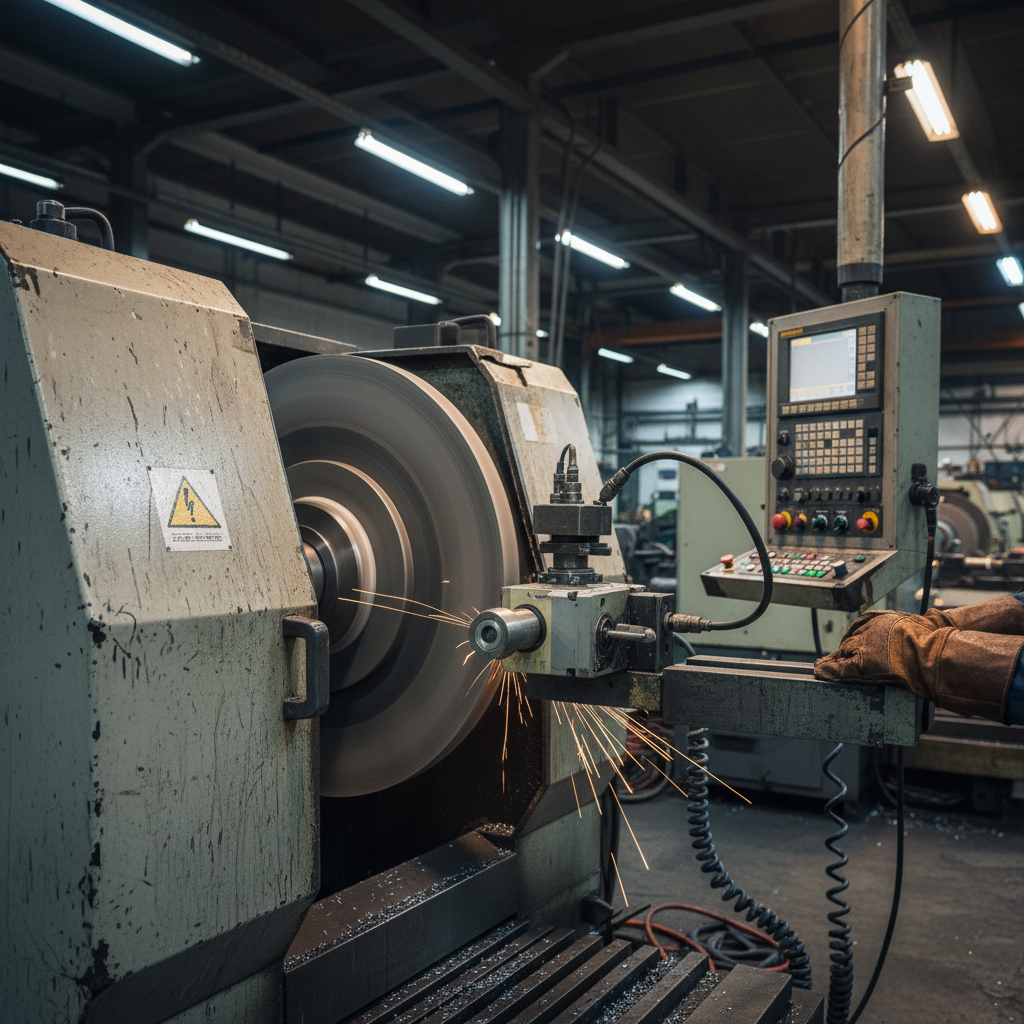
Optimizing Grinding Force Ratio and Geometric Consistency with Open-Structure Wheels
In high-precision manufacturing, achieving tight dimensional and geometric tolerances—such as roundness, cylindricity, flatness, and parallelism—presents a constant challenge for grinding engineers. When grinding difficult-to-machine materials like nickel-based superalloys, technical ceramics, titanium, and hardened tool steels, the mechanical and thermal stresses generated in the grinding zone often lead to structural deflection, thermal distortion, and premature wheel wear. The root cause of these quality issues typically lies in an unfavorable balance of grinding forces.
To establish a highly stable, repeatable, and precise grinding process, engineers must focus on two fundamental variables: the Grinding Force Ratio ($\lambda = F_t/F_n$) and Geometric Consistency. By utilizing engineered Open-Structure Grinding Wheels, manufacturers can systematically lower the normal grinding force ($F_n$), optimize the force ratio, and significantly mitigate the mechanical deflections that ruin workpiece geometry. This technical paper provides a deep dive into the tribological and mechanical dynamics of grinding forces, demonstrating how open-pore wheel architectures serve as a primary solution for high-precision B2B grinding operations.
The Physics of Grinding Forces: Normal ($F_n$) vs. Tangential ($F_t$)
Grinding is a high-energy material removal process characterized by micro-cutting, plowing, and rubbing actions from thousands of geometrically undefined abrasive grains. The total grinding force exerted on the workpiece is vectorially split into three orthogonal components: normal force ($F_n$), tangential force ($F_t$), and axial force ($F_a$). In most surface, cylindrical, and creep-feed grinding operations, axial forces are negligible, leaving $F_n$ and $F_t$ as the primary drivers of process behavior.
Normal Force ($F_n$): Operating perpendicular to the workpiece surface, $F_n$ is the force required to push the abrasive grains into the material to achieve the designated depth of cut. Because of the highly negative rake angles typical of abrasive grains, $F_n$ is always significantly larger than $F_t$, often by a factor of 2 to 5. High normal forces directly cause elastic deformation of the machine-spindle-workpiece system, resulting in geometric errors and part deflection.
Tangential Force ($F_t$): Operating parallel to the workpiece surface and in the direction of the wheel rotation, $F_t$ represents the force required to overcome material shear resistance, chip formation, and sliding friction. $F_t$ directly determines the spindle power consumption ($P_c = F_t \cdot v_s$, where $v_s$ is wheel speed) and is the force component responsible for actual material removal.
The Grinding Force Ratio ($\lambda$)
The Grinding Force Ratio is mathematically defined as:
$$\lambda = \frac{F_t}{F_n}$$
This ratio serves as a direct indicator of the grinding wheel’s cutting efficiency. A low force ratio (e.g., 0.15 to 0.25) indicates that a disproportionately high normal force is required to remove material. This is characteristic of a glazed, loaded, or dull grinding wheel where rubbing and plowing dominate the process. Conversely, a high force ratio (e.g., 0.35 to 0.55) indicates that the wheel is cutting cleanly and efficiently, with a higher proportion of energy directed toward shearing and chip formation rather than friction and plastic deformation.
How Normal Force Compromises Geometric Consistency
Geometric consistency refers to the ability to repeatedly produce workpieces within specified dimensional tolerances (e.g., maintaining a constant diameter along a shaft or a perfectly flat plane across a surface). Any variation in the mechanical forces during the grinding cycle directly compromises this consistency through three primary mechanisms:
- System Deflection (Compliance): Every grinding machine tool has a finite stiffness ($K_{sys}$). When subjected to a high normal force ($F_n$), the system deflects by a distance $Y = F_n / K_{sys}$. If $F_n$ fluctuates due to wheel glazing or uneven wheel wear, the deflection distance $Y$ varies, leading to taper issues, thickness variations, and roundness errors. This challenge is thoroughly analyzed in our guide on eliminating taper issues in titanium grinding with open-structure wheels.
- Thermal Expansion: High normal forces increase the friction between the bond/abrasive and the workpiece. This friction generates intense heat in the grinding zone. If the heat cannot be dissipated, it causes localized thermal expansion of the workpiece (thermal bowing). As the part cools post-grinding, it contracts, revealing severe flatness and profile errors.
- Elastic Recovery (Spring-Back): When grinding ductile materials, a high normal force causes significant elastic deformation of the workpiece surface. Once the wheel passes, the material “springs back,” resulting in dimensional inaccuracy and requiring multiple spark-out passes that increase cycle times.
The Open-Structure Solution: Mechanics of Pore Engineering
Standard grinding wheels often feature dense structures to maximize wheel life. However, these dense structures lack the void space necessary for efficient chip clearance and coolant transport. Open-structure grinding wheels are engineered with highly controlled, interconnected porosity (often using temporary pore-forming agents during manufacturing) to solve this limitation.
The structural difference between a conventional dense wheel and an engineered open-structure wheel is illustrated below:
| Process Parameter | Standard Dense Wheel (Structure 5-8) | Open-Structure Wheel (Structure 12-18) |
|---|---|---|
| Volumetric Porosity | 35% – 48% | 50% – 65%+ |
| Normal Force ($F_n$) | High to Extreme (Dynamic Increase) | Low and Stable |
| Grinding Force Ratio ($F_t/F_n$) | Low (0.15 – 0.25) | High (0.35 – 0.50) |
| Chip Storage Capacity | Minimal (Prone to Loading) | Excellent (Self-Cleaning) |
| Coolant Penetration | Deflected by Boundary Layer | Excellent (Internal Transport) |
| Geometric Deviation | High (Due to Deflection & Heat) | Minimal (Excellent Consistency) |
By increasing the volumetric porosity, open-structure wheels optimize the grinding force ratio and protect geometric consistency through three key mechanisms:
1. Minimizing Contact Area and Rubbing Friction
In a dense wheel, the bond posts and closely packed abrasive grains create a large contact area with the workpiece. This large contact zone increases the normal force ($F_n$) required to achieve grain penetration, leading to extensive rubbing and plowing. Open-structure wheels feature wider spacing between active abrasive grains. This reduces the real area of contact, allowing each individual grain to penetrate the material with significantly lower overall normal force, shifting the process from rubbing to efficient cutting.
2. Elimination of Wheel Loading (Chip Clearance)
When grinding ductile materials like aluminum, titanium, or nickel superalloys, micro-chips easily fuse to the wheel face—a phenomenon known as “loading.” Loaded metal fills the grain-interstices, transforming the abrasive wheel into a metallic contact surface. This spikes $F_n$ exponentially and destroys geometric accuracy. The large, interconnected pores of an open-structure wheel act as micro-pockets that temporarily store chips during the cut and safely eject them via centrifugal force as the wheel exits the grinding zone.
3. Dynamic Coolant Delivery and Boundary Layer Disruption
High-speed rotating grinding wheels generate a high-pressure air boundary layer that acts as an aerodynamic barrier, deflecting liquid coolant away from the grind zone. Open-structure wheels break this barrier. The open pores act as natural conduits, drawing coolant into the wheel body and releasing it directly at the point of contact under centrifugal pressure. This continuous lubrication reduces friction-induced $F_t$ and thermal expansion, ensuring excellent geometric stability. For a detailed breakdown of managing these forces in ultra-hard materials, see our study on controlling normal forces in PCBN grinding.
Material-Specific Case Studies: Force Optimization in Action
The practical value of optimizing the grinding force ratio through open-structure wheels is best demonstrated across three highly challenging material classes:
Conclusion
Optimizing the grinding force ratio is not merely a theoretical exercise; it is a practical necessity for high-precision manufacturing. Open-structure grinding wheels provide the physical architecture required to manage the delicate balance between normal and tangential forces. By facilitating chip evacuation, reducing thermal friction, and ensuring continuous self-sharpening of the abrasive grains, these wheels minimize structural deflection and thermal damage. For B2B manufacturers operating in the aerospace, automotive, and tooling sectors, adopting engineered open-structure wheels is a decisive step toward achieving unmatched geometric consistency, reduced cycle times, and superior surface integrity.
Partner with Precision Grinding Experts
Achieving the perfect balance between grinding force ratios and geometric tolerances requires high-performance, custom-engineered abrasives. Whether you are grinding complex aerospace superalloys, advanced technical ceramics, or hardened tool steels, our technical engineering team is ready to design the ideal open-structure wheel solution for your specific application.
Contact us today to optimize your grinding processes, eliminate thermal defects, and elevate your production efficiency:
Zhengzhou Zhongxin Grinding Wheel Co., Ltd.
Email: root@shalun.net
Phone/WhatsApp: +86 15538050608
Telephone: 0371-62513386
Address: No. 1111-1, Kexue Avenue, Shangjie District, Zhengzhou, Henan, China.