


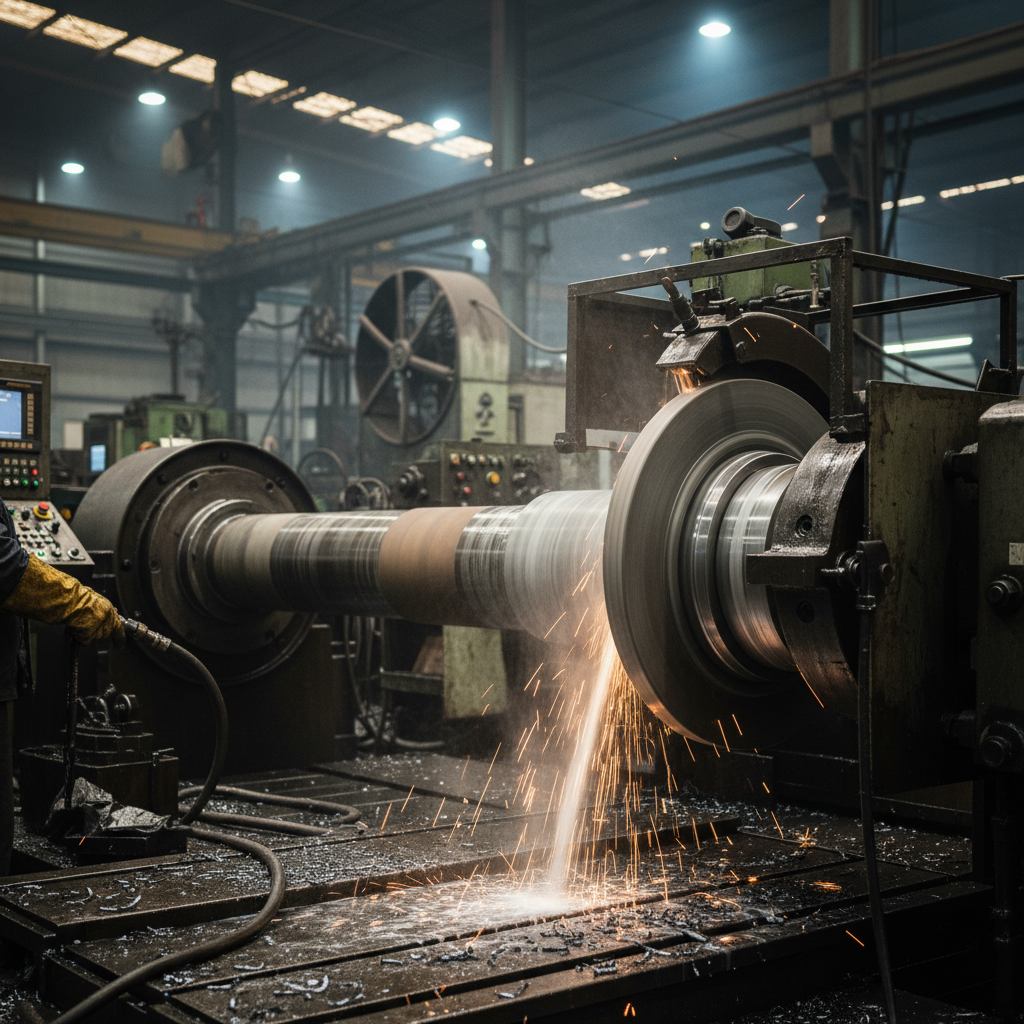
The Criticality of Railway Axle Surface Integrity in High-Speed Transport
In the modern landscape of rail transport, the demand for higher speeds and heavier load capacities has pushed mechanical components to their physical limits. Among these, the railway axle stands as perhaps the most safety-critical component. It supports the entire weight of the vehicle while enduring continuous cyclic loading. This environment makes fatigue failure the primary concern for engineers. Fatigue life is not just a function of the material’s bulk properties but is heavily influenced by the surface finish and the “near-surface” metallurgical state created during manufacturing. Grinding is the final and most critical machining stage in axle production. It defines the final dimensions and, more importantly, the surface integrity. Poorly optimized grinding leads to residual tensile stresses, micro-cracks, and heat-affected zones (HAZ). Conversely, a simulation-driven approach allows manufacturers to predict these outcomes before a single wheel touches the steel, ensuring that the axle enters service with a surface profile optimized for longevity. At Zhengzhou Zhongxin Grinding Wheel Co., Ltd., we have seen how moving from trial-and-error to simulation-based parameters can extend the fatigue life of an axle by up to 30%.Understanding the Mechanics of Axle Fatigue and Grinding Interaction
Railway axles are typically manufactured from high-strength alloy steels like EA1N or EA4T, which are heat-treated to achieve a balance of toughness and hardness. During the grinding process, the interaction between the abrasive grains and the workpiece generates significant heat. If this heat isn’t managed, it causes localized thermal expansion and subsequent contraction, leading to tensile residual stress. In the context of fatigue, tensile stress is the enemy. It “pulls” at micro-defects, encouraging crack initiation. On the other hand, compressive residual stress “pushes” the material together, effectively hindering crack growth. The goal of precision grinding for railway axles is to achieve a surface with high compressive stress and a low roughness (Ra) value, typically between 0.2 µm and 0.8 µm. Achieving this consistently requires a deep understanding of the grinding wheel’s behavior and the cooling dynamics.Thermal Damage and Phase Transformation
When we talk about grinding damage, we are primarily concerned with thermal influence. During the grinding of alloy steels, the temperature at the contact zone can easily exceed 800°C or even 1000°C if the parameters are not optimized. This heat doesn’t just change the stress state; it can change the material structure itself. If the temperature exceeds the Ac1 transformation point of the steel, we risk “re-hardening.” This creates a brittle layer of untempered martensite on the surface. Under the cyclic stress of a high-speed train, this brittle layer is a breeding ground for micro-cracks. Simulation allows us to map the “thermal flux” and ensure that the temperature remains well below the tempering temperature of the axle steel, maintaining the integrity of the heat treatment.Simulation-Driven Optimization: FEA and Thermal Modeling
The use of Finite Element Analysis (FEA) has revolutionized how we approach grinding parameters. By creating a digital twin of the grinding zone, we can simulate the “Moving Heat Source” model. This model calculates the temperature distribution across the axle surface based on wheel speed, work speed, and depth of cut. One of the most valuable aspects of simulation is predicting the Grinding Burn threshold. Grinding burns occur when the temperature exceeds the material’s tempering temperature, causing a localized softening or even re-hardening. These areas act as stress concentrators. Using FEA, we can identify the “critical heat flux” for a specific alloy. For instance, when grinding EA4T steel, keeping the surface temperature below 500°C is vital to prevent significant metallurgical changes.From Mesh Generation to Stress Prediction
A detailed simulation starts with a high-fidelity mesh of the axle journal area. We apply boundary conditions that represent the coolant flow and the abrasive contact. By inputting the specific thermal conductivity and specific heat of the alloy steel, the software can predict the residual stress profile up to 500 microns below the surface. This depth is critical because fatigue cracks often originate just below the surface in the zone of peak tensile stress. By adjusting the simulated wheel speed or feed rate, we can “move” the stress profile until the surface is safely in a state of compression.Abrasive Material Selection: CBN vs. Conventional Alumina
Choosing the right abrasive is a technical decision based on the hardness and thermal conductivity of the workpiece. For railway axles, which are often hardened or induction-hardened alloy steels, the choice usually boils down to White Fused Alumina (WFA), Pink Fused Alumina (PA), or Cubic Boron Nitride (CBN).- White Fused Alumina (WFA): This is a standard choice for many axle applications. It is friable, meaning the grains break down to expose new sharp edges, which keeps the grinding temperature lower. However, WFA wheels wear faster, requiring more frequent dressing to maintain the axle’s geometric tolerances. It is generally preferred for roughing where bulk removal is the priority.
- Cubic Boron Nitride (CBN): For high-volume production and maximum fatigue life, CBN is superior. It has a thermal conductivity much higher than alumina, which allows it to pull heat away from the grinding zone and into the wheel/coolant more effectively. This drastically reduces the risk of thermal damage. Furthermore, vitrified bond CBN wheels hold their profile for much longer, ensuring consistent Ra values across hundreds of axles.
Optimizing the Grinding Parameters: A Technical Breakdown
To achieve an enhanced fatigue life, the grinding parameters must be carefully balanced. It is not just about the wheel, but how the wheel is used. In our simulation studies, we focus on several key variables that have the highest impact on surface integrity. 1. Wheel Speed (Vs): For alumina wheels, speeds of 30-45 m/s are standard. For CBN, we can push this to 60-120 m/s. Higher speeds generally result in better surface finishes because the “chip thickness” per grain is smaller. However, this requires better cooling systems to prevent “air-barrier” effects where the coolant is blown away from the contact zone. 2. Workpiece Speed (Vw): A higher workpiece speed reduces the contact time between any single point on the axle and the grinding wheel, which helps in reducing the cumulative heat input. For a typical 160mm diameter axle, a work speed of 20-30 m/min is often a good starting point for optimization. 3. Depth of Cut (Ae): Roughing passes might take 0.03 mm to 0.05 mm per pass. For the final finishing passes, this should be reduced to 0.005 mm or less. This “spark-out” phase is essential for neutralizing residual stresses and achieving that mirror-like Ra 0.2-0.4 µm finish.Grit Size Selection and Surface Roughness
The selection of grit size is a trade-off between material removal rate (MRR) and surface finish.- Roughing (46# – 60#): These larger grits are designed for efficient removal of the turning marks left by the lathe. They create a rougher surface (Ra 1.6 – 3.2 µm) but avoid excessive heat buildup if the wheel structure is open (porous).
- Finishing (80# – 120#): These finer grits are used to achieve the final surface specifications. For railway axles, a grit size of 100# or 120# is often ideal for reaching an Ra of 0.4 µm without needing excessive spark-out time.
The Role of Bond Systems in Heat Management
The “bond” is what holds the abrasive grains together. In railway axle grinding, we primarily use Vitrified or Resin bonds. Vitrified bonds are ceramic-like and very rigid. They allow for a high degree of porosity, which is vital for carrying coolant into the grinding zone and providing space for the metal chips. This “induced porosity” is a key feature of Zhengzhou Zhongxin’s high-performance wheels, as it significantly lowers the grinding temperature. Resin bonds, while tougher and more shock-absorbent, tend to generate more friction and are generally reserved for applications where wheel breakage is a concern or for specific polishing stages.Managing the Grinding Zone: Coolant and Dressing
Even with the best simulation and the highest quality CBN wheel, poor coolant application can ruin an axle. The coolant serves two purposes: lubrication to reduce friction and cooling to remove generated heat. In railway axle grinding, high-pressure coolant nozzles must be aimed precisely at the “nip” where the wheel meets the steel. Dressing is the other half of the equation. A “glazed” wheel, where the abrasive grains have become dull, will generate excessive friction and heat. Simulation-driven maintenance schedules tell us exactly when to dress the wheel. For a 60# alumina wheel, dressing every 5-10 axles might be necessary to maintain a “sharp” cutting action that induces compressive stress rather than tensile heat.Surface Integrity Inspection: Beyond the Naked Eye
Quality assurance for optimized axles involves more than just measuring diameter. To verify the success of a simulation-driven process, we use advanced metrology and non-destructive testing (NDT):- Barkhausen Noise Analysis: A non-destructive method to detect grinding burns and changes in residual stress. It is sensitive to both microstructural changes and stress states.
- X-Ray Diffraction (XRD): To measure the actual depth and magnitude of residual compressive stresses. This is the gold standard for verifying that the grinding process has achieved its target stress profile.
- Profilometry: To ensure the Ra, Rz, and Rmax values meet the stringent requirements of rail standards like EN 13261 or AAR M-101.
Economic Impact and Sustainability of Optimized Grinding
Investing in simulation-driven grinding is not just a technical choice; it’s an economic one. By reducing the occurrence of grinding burns, manufacturers can significantly lower their scrap rates. In the production of expensive alloy steel axles, a single scrapped component can cost thousands of dollars. Furthermore, axles with enhanced fatigue life require less frequent replacement. This leads to lower lifecycle costs for rail operators and reduces the environmental impact associated with the production of new steel components. Sustainable manufacturing in the rail industry starts with making components that last longer.The Future of Axle Manufacturing
The transition to simulation-driven grinding is not just a trend; it is a necessity for the next generation of high-speed rail. By integrating FEA predictions with high-performance abrasives, manufacturers can produce axles that are lighter, stronger, and more resistant to the rigors of transcontinental travel. Optimizing the grinding process is a continuous journey. As materials evolve—such as the introduction of new micro-alloyed steels—the simulation models must be updated, and the grinding wheels must be reformulated to match the new hardness and thermal properties.About Zhengzhou Zhongxin Grinding Wheel Co., Ltd.
Zhengzhou Zhongxin Grinding Wheel Co., Ltd. is a leader in the research and production of high-precision abrasive tools. We specialize in providing customized grinding solutions for the railway, automotive, and aerospace industries. Our products, ranging from high-grade alumina wheels to advanced vitrified CBN systems, are designed to meet the most demanding surface integrity requirements. We combine decades of manufacturing expertise with modern simulation techniques to help our clients optimize their production lines, reduce waste, and enhance the safety of their components. Our facility in Henan Province is equipped with the latest testing equipment to ensure every wheel we ship meets international quality standards. Contact Information:Email: root@shalun.net
Phone: 15538050608 | 0371-62513386
Address: No. 1111-1, Kexue Avenue, Shangjie District, Zhengzhou City, Henan Province, China. Whether you are looking to solve a specific grinding burn issue or want to overhaul your axle production process for better fatigue life, our team of engineers is ready to assist. Reach out to us for a technical consultation or a quote on our specialized railway axle grinding wheels. At Zhengzhou Zhongxin, we don’t just sell wheels; we provide the precision that keeps the world moving safely.